








¶Table of Contents
¶Quick facts
The Irish Red Setter is an energetic pointing gundog from Ireland, with a chestnut-red coat and a friendly, alert expression. Bred to search for and point game birds in partnership with a hunter, this elegant dog has a strong desire to work and needs plenty of activity. It is best suited to a lifestyle that combines hunting, training and family life.
- Size: males stand 58–67 cm at the withers and females 55–62 cm, according to the FCI breed standard.
- Activity level: very high. Needs daily physical exercise, mental stimulation and opportunities to use its searching instincts.
- Grooming: regular brushing and thorough combing several times a week, with extra attention to the ears, paws and feathering.
- Life expectancy: around 12–15 years according to the AKC, as a guide rather than a guarantee for any individual dog.
- Best suited to: an active owner who appreciates an affectionate hunting dog and has time for purposeful training, outdoor activity and grooming.
Ask the breeder what the dogs in the particular family line are used for. Working and more show-focused lines can differ in size and coat, among other things, but a show background does not automatically mean a dog will need less exercise. Meet adult relatives and discuss what they are like both at home and outdoors. Base your decision on the life you can offer throughout the dog’s lifetime, including when the weather is bad or work takes up a lot of your time.

¶Appearance and coat
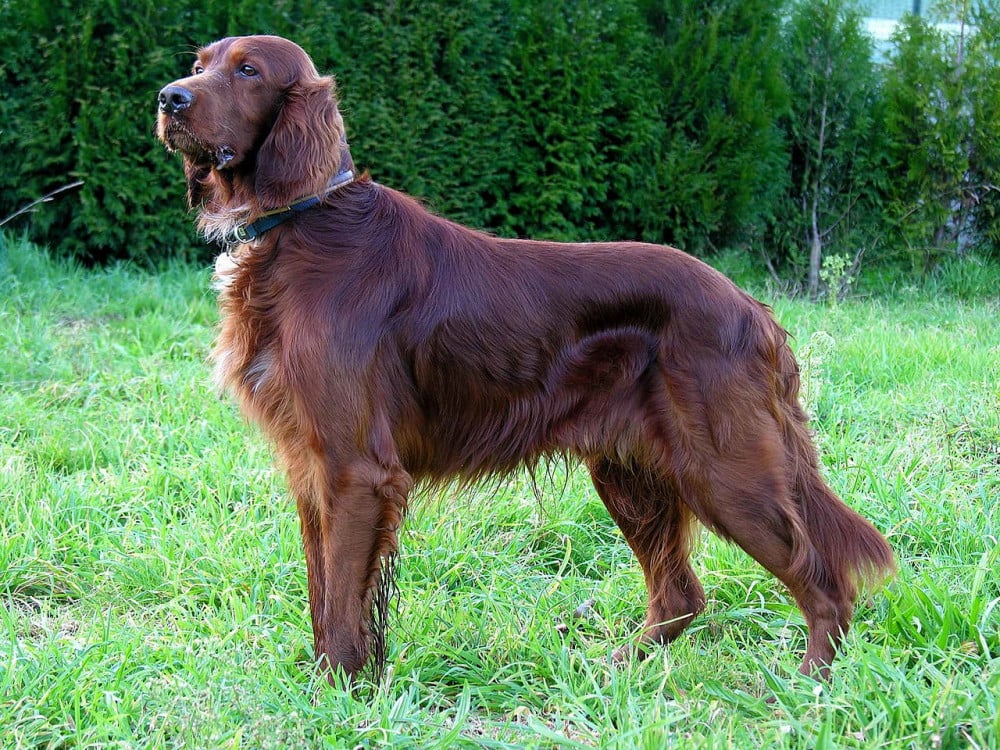
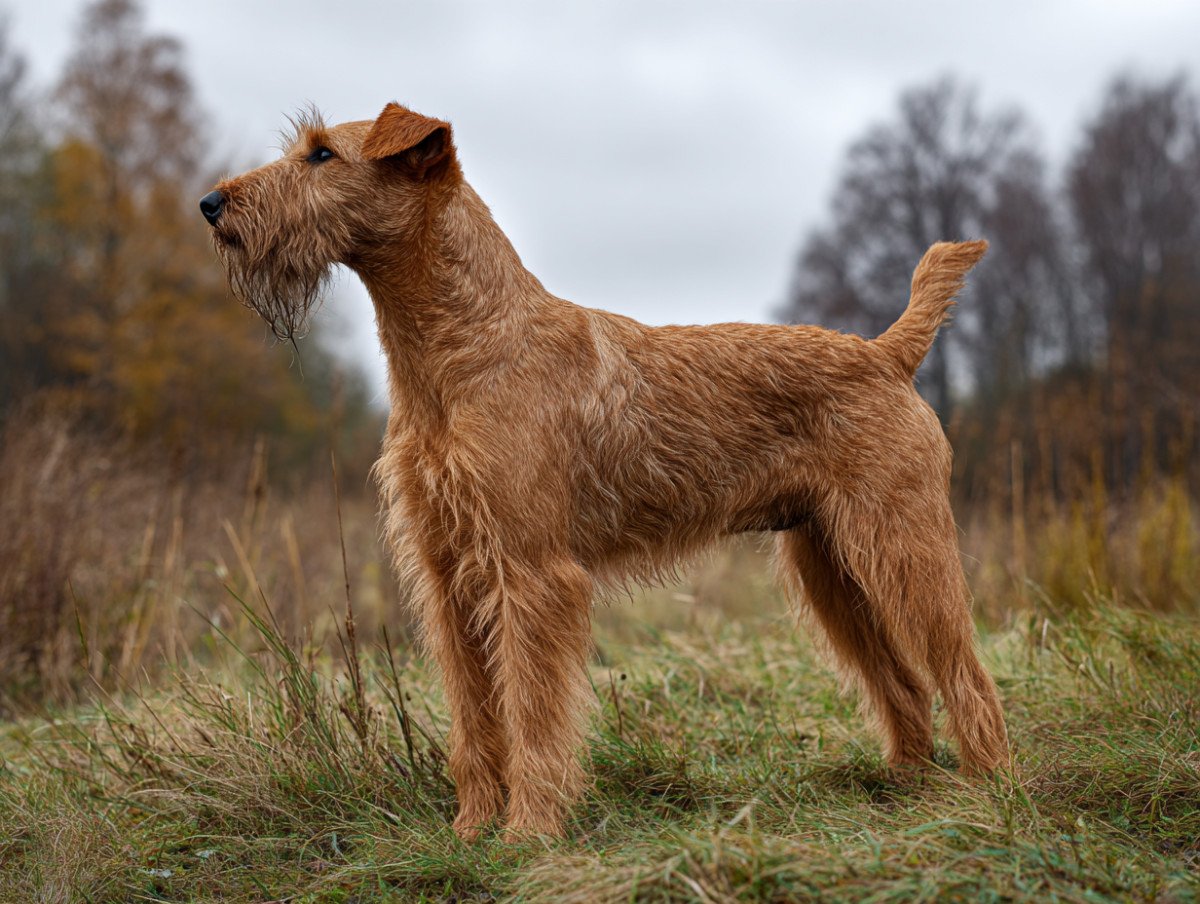
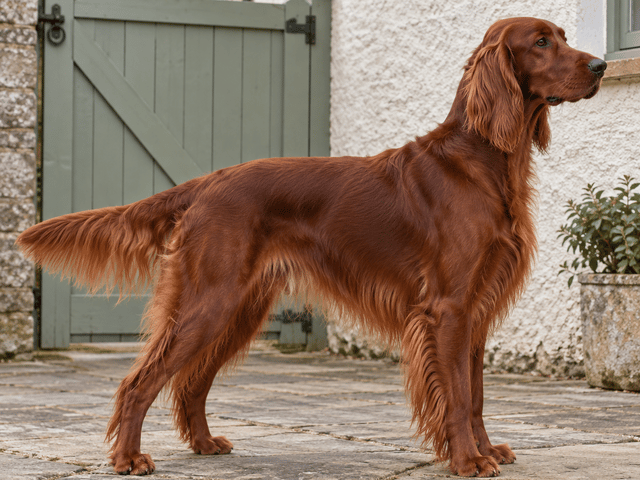
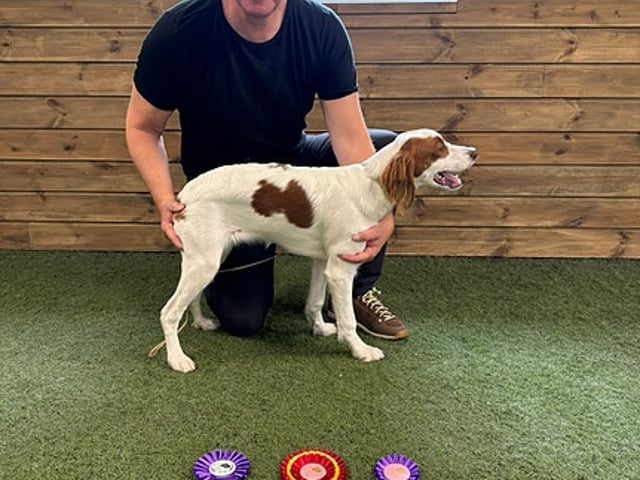
The Irish Red Setter should look athletic and well balanced. The head is long and lean, with dark hazel or dark brown eyes and low-set ears that hang close to the head. The neck is muscular and slightly arched. The chest is deep, and the legs are built for free, efficient movement. The overall appearance should combine elegance with the strength needed for work.
The coat is a rich chestnut red, with no black. Small white markings on certain parts of the body, such as the chest and toes, are not necessarily outside the standard. The hair is shorter on the head and the fronts of the legs, while the ears, backs of the legs, belly and tail have longer feathering. The tail is carried level with the back or lower. The coat should generally lie flat and be as free from curl as possible.
Expect to brush and comb the coat several times a week. Work gently through the feathering, paying particular attention to the ears, neck and paws, where tangles can easily form. After outings in the countryside, check for any debris caught in the coat. Ask the breeder to show you how to keep the coat tidy and practical without excessive styling. The amount of work involved depends on the individual dog’s coat and activities.
Use grooming time to check the skin, ears, nails and paws as well. Persistent odour, redness, tenderness or head shaking should be assessed by a vet. Get your dog used to being examined from an early age, as well as having its teeth brushed with products intended for dogs. Short, calm practice sessions make routine care easier. Ask for help with nail trimming or grooming if you are unsure how to do it.
¶Temperament and personality
Affection, energy and intelligence are key traits of the Irish Red Setter. The American breed club also describes a playful dog that matures slowly and may retain much of its youthful exuberance. This can make everyday life fun, but it calls for patience when an adolescent dog cannot yet manage everything you hope for. Plan to teach everyday skills gradually and reward the behaviours you want to see more often.
The breed’s hunting instinct needs to be taken seriously, even if the dog is primarily a companion. An interesting scent or bird may prove more compelling than staying connected with its handler. This is a trait to plan for, not something that disappears simply because the dog is friendly and people-oriented. Discuss with the breeder early on how you will meet the dog’s need to work and which environments offer safe opportunities for activity.
Socialisation is about building confidence around people, dogs, different environments and handling. Give your puppy positive experiences at a manageable pace, adjusting the level of challenge to its reactions. Although the breed is often described as sociable, that does not mean every individual wants to greet everyone or can cope with every situation straight away. Ask how the breeder works with the puppies and how the parents respond to visitors, unfamiliar places and everyday distractions.

¶Training and exercise
A healthy adult Irish Red Setter needs an active daily routine with plenty of time outdoors and activities that engage both body and mind. The UK Kennel Club places the breed in its category for more than two hours of exercise a day. Treat that as an indication of the commitment involved, rather than a fixed schedule for every dog. Adjust exercise to suit age, health and fitness, and allow time to rest between activities.
For owners interested in hunting, searching, working with game birds, steadiness and retrieving are natural parts of training. Consider seeking help from a club or instructor experienced with pointing gundogs. Tracking, obedience, rally obedience and other activities that involve working together can add variety. Choose activities that engage your dog and build up the difficulty gradually. A walk where the dog simply accompanies you may not offer the same challenge as a well-planned training session.
Train consistently using rewards, and keep exercises interesting. Spend time on recall, checking in with you, loose-lead walking and waiting calmly when something exciting happens. Start with minor distractions before trying more challenging situations. Use a lead or long line wherever hunting instincts might lead your dog to run off, and choose securely enclosed areas for off-lead exercise. Even a reliable recall still needs to be supported by thoughtful choices about where you let your dog loose.
¶Health
Hip dysplasia, or HD, is an important health concern in the breed. To register a litter with the Swedish Kennel Club (SKK), both parents must have an official hip assessment before mating. The breed also has an HD index to support breeding decisions. Ask for the dogs’ registered identities and check their results in Hunddata or Avelsdata. Ask about the health of older relatives too; a single examination does not give the full picture of a family line’s health.
CLAD affects white blood cell function and makes affected dogs highly susceptible to infections. Sweden’s previously mandatory DNA testing requirement was removed in 2014, but results are still recorded. In 2025, SKK approved central recording of DNA results for rcd4-PRA, an inherited retinal disease, in the Irish Red Setter. SISK’s own breeding criteria include a recorded, approved status for CLAD and rcd4-PRA. Club approval and SKK registration rules are separate sets of requirements; check both before any planned mating.
Ask the breeder to explain exactly which disease variants have been tested for and what the parents’ results mean for the pairing. rcd1-PRA and rcd4-PRA are different variants, and a DNA test for one does not rule out the other or all eye diseases. Also ask about epilepsy, for example, and any other recurring diagnoses among relatives. A statement that the dogs are “tested” should always be followed by details of the test, the dog’s identity and the result.
Gastric dilatation-volvulus, also known as bloat or a twisted stomach, occurs in the breed and is a life-threatening emergency. Signs may include repeated attempts to vomit without bringing anything up, restlessness, excessive salivation and a swollen abdomen. The swelling may not be obvious at first. Contact a vet immediately if these signs occur; do not wait for them to pass. Ask your vet to explain what to watch for and how to access emergency care.

¶History and origins
The Irish Red Setter was developed in Ireland as a working gundog. According to the FCI, it descends from the Irish Red and White Setter crossed with an unknown solid-red dog, and the breed type was clearly established during the 18th century. Selective breeding produced a dog that could search for game birds with speed and stamina. This background explains why the desire to work remains such an important part of the breed’s description.
The Irish Red Setter Club was founded in 1882 and published a breed standard in 1886. Since then, the club has been involved in both field trials and dog shows. During the 19th century, the Irish Red Setter also grew in popularity beyond Ireland. Today, these dogs take part in hunting, dog sports and family life, but the breed retains its origins as a pointing gundog. The Irish Red and White Setter is a separate breed and should not be confused with the Irish Red Setter.
¶Living with the breed
Life with an Irish Red Setter suits someone who wants plenty of shared activity and a close bond with their dog. Plan for the whole day, not just the longest walk. Your dog also needs time to eat, rest, be groomed and practise everyday skills in a calm setting. Before buying, consider drawing up a realistic weekly plan that makes room for both training and practical coat care.
In a family with children, adults need to take responsibility for the dog’s needs and its interactions with the children. A lively dog can be overwhelming even when it means well. Teach children to respect the dog’s food, rest and need to retreat, and supervise their interactions. The breed’s affectionate reputation is no substitute for adult supervision or for teaching dogs and children how to spend time together safely.
Compatibility with other pets needs to be assessed individually. The breed’s hunting background makes it particularly important to prevent chasing smaller animals. Introduce a cat slowly, use distance and barriers, and give the cat safe spaces and escape routes of its own. Reward calm behaviour and intervene before the dog starts to chase. Getting along with a particular cat at home does not reliably indicate how the dog will react to unfamiliar animals outdoors.
Assess your home in terms of the actual opportunities it offers for activity, rest and safe management. A large garden does not, by itself, give a dog meaningful work, and an unenclosed garden is not a safe place for off-lead exercise. Think through fencing, doors and gates. If you live close to neighbours, you also need to be able to manage calm arrivals, departures and toilet breaks without every outing becoming an overexciting event.
Introduce time alone gradually once your puppy feels secure at home. Start with very short periods at calm moments and increase them according to how your dog actually responds. A breed name cannot tell you how long an individual dog can cope with being alone. Arrange a dog sitter or other help if your working day would otherwise leave the dog alone for too long, and seek support early if your dog shows clear distress when you leave.
Before buying, it is wise to weigh up three things: the family line’s working and health history, the individual dog’s traits and your own daily life. Ask the breeder to describe both the enjoyable and the demanding aspects of living with their adult dogs. When you appreciate the hunting instinct as much as the friendly companionship, and can make time for both, you give this breed a good chance to thrive.
¶Characteristics
¶Frequently Asked Questions
¶Comparisons with Other Breeds
Compare Irish Red Setter with other breeds and see the differences in temperament, activity level, and care to make a confident choice. Show All Comparisons