
¶Table of Contents
¶Quick Facts
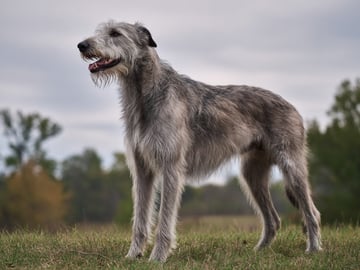
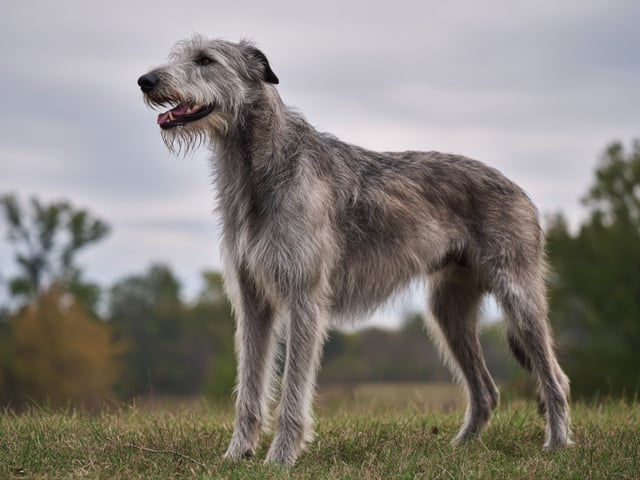
The Irish Wolfhound is a very large, rough-coated sighthound from Ireland. It combines a sighthound's speed and hunting instinct with a generally friendly nature, but its size affects almost every practical decision, from the car and home to the way a puppy is raised.
- Breed type: A sighthound in FCI Group 10, originally used to hunt wolves and other large game.
- Size: The standard sets minimums of 79 cm and 54 kg for dogs and 71 cm and 41 kg for bitches. An average height of 81–86 cm is desirable for dogs; there is no stated maximum height or weight.
- Build: Powerful and muscular, but not as massive as a Great Dane. It should carry more substance than a Scottish Deerhound without losing the lines and mobility of a sighthound.
- Temperament: Usually friendly, affectionate and calm at home. Hunting drive can be strong and varies between individuals.
- Activity: Needs daily exercise, mental stimulation and safe opportunities to stretch out at speed. The amount should reflect age, fitness and recovery.
- Coat: Rough and hard on the body, legs and head, with marked eyebrows and a beard. It needs regular attention but should not be clipped like a soft-coated companion breed.
- Worth knowing: The breed has a shorter life expectancy than many smaller dogs. Heart health, early puppy testing for portosystemic shunt and disease in close relatives are important questions before buying.
¶Appearance & Coat
An Irish Wolfhound should be large and imposing without looking heavy or clumsy. It has a long body, deep chest, well-muscled limbs and a long, gently curved tail. Movement should be easy and active. It is less massive than a Great Dane, while carrying more weight and power than a Scottish Deerhound.
The size figures are often misunderstood. The standard gives minimum measurements for both sexes and a desirable average of 81–86 cm for dogs, but no official maximum. A bitch's size and the eventual weight of either sex cannot therefore be read as a narrow range. Proportion, strength and sound movement matter more than aiming for the largest possible dog.
The coat should be rough and hard, particularly above the eyes and under the jaw. Permitted colours include grey, brindle, red, black, pure white and fawn, as well as the colours seen in the Scottish Deerhound. Comb and brush as the individual coat requires, tease out tangles and remove dead, untidy hair without stripping away the protective topcoat. Check the beard, ears, feet, nails and skin too. Bathing should be guided by dirt, skin condition and daily life, not a fixed timetable.
¶Temperament & Personality
The Irish Wolfhound is generally friendly and people-oriented, but a breed description cannot guarantee the character of every dog. Early socialisation, the parents' temperaments and the dog's own experiences all affect confidence and sociability. Because of its size, even an enthusiastic greeting, play or a sudden pull on the lead calls for good control.
This is a sighthound with a hunting background. A dog that is quiet indoors may react in an instant to a deer, hare or running cat. Off-lead freedom should therefore depend on the individual's proven recall and the surroundings, not on the assumption that a gentle manner means little prey drive. A securely fenced area is often the best place for full-speed running.
Many live happily with other dogs. Life with cats or smaller animals is more individual: a puppy may learn the rules at home without losing its chase response outdoors. Introduce animals calmly, give the cat escape routes and keep physical control of the dog until their behaviour together is predictable.
A steady adult can be gentle and patient with children, but active adult supervision is still essential. The dog's body can knock over a small child unintentionally. Teach children to leave the dog alone while it eats or sleeps and give the dog a resting place where it will not be disturbed.
¶Training & Exercise
An Irish Wolfhound needs consistent, kind training that still works when the dog outweighs its handler. Start early with attention, loose-lead walking, recall, handling and calm passage past people, dogs and wildlife. Short, clear sessions and rewards usually suit the breed better than harsh corrections or long, repetitive drills.
Build recall gradually, moving from easy settings to more difficult distractions. Use a long line in unfenced places until recall remains reliable around likely prey. No training method can promise that a sighthound will always abandon a chase, so a lead and fencing are safety tools, not signs of failed training.
An adult benefits from varied walks, scent-based activities and opportunities to move more freely in a safe place. No evidence-based number of minutes suits every dog. Instead, watch its gait, breathing, willingness and recovery during and after exercise. Increase exertion gradually and adjust it in hot weather, during illness or when fitness is poor.
Puppies grow quickly and should be allowed to play and move at their own pace. Avoid long repetitive distances, high jumping and hard fitness work before the body has matured. Everyday movement, play on suitable surfaces, breaks and new environments build both body and confidence. Ask for advice based on the individual puppy's growth and body condition rather than using a universal minutes-per-month formula.
¶Health
A healthy start depends on choosing a breeder carefully, followed by appropriate care throughout life. Irish Wolfhounds have a shorter life expectancy than many smaller breeds. Swedish and international evidence particularly highlights heart disease, cancer, pneumonia and portosystemic shunt. Individual dogs may remain healthy for a long time, but the breed's risks should not be played down.
Dilated cardiomyopathy, or DCM, and the rhythm disorder atrial fibrillation occur in the breed. Atrial fibrillation can be present before an owner notices clear symptoms and may precede heart muscle disease. Echocardiography shows the heart's structure and pumping function, while an ECG assesses its rhythm; the two tests answer different questions and may need to be combined. Ask when both parents were last examined, which methods were used and what is known about hearts in earlier generations. A normal result reduces uncertainty at that time but cannot guarantee that disease will never develop.
In a portosystemic shunt, or PSS, blood is diverted past the liver. The breed has an established early bile-acid check, usually performed when puppies are about six to eight weeks old and before they leave the breeder. Ask to see the litter's results and how any abnormal value was followed up. This is more informative than a general assurance that the line is healthy.
Osteosarcoma and other cancers, as well as serious pneumonia, are among the breed club's health priorities. Persistent lameness, pain or swelling needs veterinary assessment. Seek help promptly for marked lethargy or respiratory symptoms too, as pneumonia can develop rapidly and severely in this breed.
The deep chest also brings a risk of gastric dilatation-volvulus, or GDV. Repeated unsuccessful attempts to vomit, a rapidly swollen or painful abdomen, pronounced restlessness, pale gums, weakness or collapse are emergency warning signs. Go straight to a vet; this cannot be treated at home. Discuss individual risk and possible preventive gastropexy with a vet. The operation reduces the risk of the stomach twisting but does not prevent every episode of bloating.
When assessing a litter, distinguish compulsory registration rules from breed-club health recommendations. The absence of a compulsory result does not make a health question unimportant. Ask for dated examination reports, the puppy's PSS result and straightforward information about longevity and causes of death among close relatives.
¶History & Origins
The Irish Wolfhound has roots in Ireland's large hunting dogs, but the modern breed is the result of a documented nineteenth-century reconstruction, not an unchanged line stretching back to antiquity. In AD 391, a Roman consul wrote about Irish dogs sent to Rome. Such dogs were used to hunt wolves and other large game.
Once wolves disappeared from Ireland, the need for these dogs declined and the type came close to extinction by the end of the seventeenth century. In the later nineteenth century, Captain George Augustus Graham gathered the remaining dogs thought to represent the type and rebuilt the breed. Scottish Deerhounds were used in the process, with occasional Borzoi and Great Dane crosses. The breed was shown in its own class in 1879, and the Irish breed club was founded in 1885.
This modern history explains both the relationship with other large sighthounds and why legends about ancient wolfhounds should not be treated as a complete pedigree for today's dogs. The first Irish Wolfhound arrived in Sweden in 1931, and the Swedish Irish Wolfhound Club was formed in 1976.
¶Living with the Breed
Living with an Irish Wolfhound is chiefly about space, safety and planning ahead. The breed can live in a flat if it receives suitable activity and the home works in practice, but a very large dog needs room to turn and rest, non-slip surfaces and an easy route outside. Several flights of stairs without a lift are especially difficult for a growing puppy or an injured adult that cannot be carried.
Test the car with an adult dog in mind: it must be able to lie safely, get in without risky jumps and still be transported if it becomes ill. Check that gates and fences can contain a tall, fast dog. A supportive bed, stable food and water bowls and enough room around meals also make daily life easier.
Time alone must be introduced gradually in short, secure stages. A calm breed is not automatically comfortable with long days alone, and a large distressed dog can harm both itself and the home. Arrange a dog sitter or other help before buying if working days will regularly exceed what the dog can manage.
These questions are particularly useful when choosing a breeder:
- Can you meet the dam, and how do both parents behave around people, dogs and ordinary environments?
- When were both parents last examined by echocardiogram and ECG, and what results are known in close relatives?
- Has the whole litter been tested for PSS before leaving, and will you receive a copy of the result?
- What longevity and causes of death are known among the parents, siblings and previous offspring?
- How will you provide secure exercise, transport, insurance and help if the dog cannot walk unaided?
The right home need not be the largest, but it must be practically prepared. Someone who appreciates a friendly sighthound, can manage its hunting drive and has the budget and space for a very large dog may find a distinctive companion. Anyone wanting reliable off-lead freedom everywhere, owning a small car or expecting a dog to tolerate long days alone should choose another breed.
¶Characteristics
| Characteristic | Value |
|---|---|
| Breed Type | Purebred |
| Aggressiveness | 3/5 |
| Child Friendly | 5/5 |
| Energy | 3/5 |
| Hair Shedding | 3/5 |
| Health | 3/5 |
| Intelligence | 3/5 |
| Grooming Needs | 3/5 |
| Learning Ability | 3/5 |
| Barking Level | 1/5 |
| Height | 71 – 90 cm |
| Weight | 40 – 69 kg |
| Life Expectancy | 6 – 8 years |
¶Frequently Asked Questions
Is an Irish Wolfhound a good family dog and how gentle are they with children?
They are typically very gentle, patient and tolerant with children, often described as having a soft, calm temperament. Their sheer size, however, means supervision is important around small kids, as they can accidentally knock them over. They do best in homes where children are taught to be respectful and calm around large dogs.
How much space and exercise does an Irish Wolfhound really need?
This is a giant sighthound that needs room to stretch out and move comfortably, ideally with access to a securely fenced yard. Daily walks plus some opportunities for free running in a safe area are important, but intense or repetitive high‑impact exercise should be limited, especially while growing. Indoors, most are relatively calm and tend to be quite sedentary once their exercise needs are met.
How long do Irish Wolfhounds live and what health problems are most common?
The average life expectancy is relatively short, often around 6 to 8 years. Common health concerns include dilated cardiomyopathy, bloat and gastric torsion, osteosarcoma, hip and elbow dysplasia, and certain hereditary eye and neurologic conditions. Responsible breeders screen for many of these problems, and owners should work closely with a veterinarian familiar with giant breeds.
Are Irish Wolfhounds aggressive or difficult to manage because of their size?
They are generally not aggressive and are known for a calm, even‑tempered and somewhat reserved nature. Proper early socialization and positive training are important so their great size stays manageable in everyday situations. Poor manners in a dog this big can be a real problem, so consistency from puppyhood is essential.
Can an Irish Wolfhound live in an apartment or small house?
They can live in a smaller home if the interior layout allows room to move and lie down comfortably, and if they receive regular outdoor exercise. Stairs, slippery floors and cramped spaces can be hard on their joints and make daily life awkward. Access to elevators, soft bedding and nearby green space helps make apartment living more realistic.
What are the grooming needs of an Irish Wolfhound’s rough coat?
The harsh, wiry coat needs regular brushing, usually several times a week, to remove dead hair and prevent matting, especially on the beard, legs and belly. Many owners hand strip or have a groomer tidy the coat occasionally to keep its correct texture. Bathing is needed only as required, but routine ear, nail and dental care are important due to the dog’s size and weight.
How much does it cost to feed an Irish Wolfhound and are there special dietary needs?
Feeding a healthy adult can be expensive, as they eat significantly more than medium‑sized dogs and do best on a high‑quality large or giant breed diet. Puppies in particular need carefully controlled nutrition to support slow, steady growth and reduce joint stress. Many owners split meals into two or three portions a day and avoid vigorous activity around feeding times to help reduce bloat risk.
Are Irish Wolfhounds good off leash, or will they chase wildlife?
They are sighthounds with a strong instinct to chase moving objects such as deer or small animals. Recall can be improved with training, but many individuals are not reliably safe off leash in unenclosed areas. Most experts recommend off‑leash running only in securely fenced spaces or very controlled environments.
How fast do Irish Wolfhound puppies grow and what should owners watch for?
Puppies grow extremely quickly during the first year, often reaching close to adult height by 9 to 12 months, while continuing to fill out afterward. Rapid growth puts stress on bones and joints, so it is important to avoid over‑feeding, excessive jumping, long runs and slippery surfaces. Owners should monitor for lameness, joint swelling or awkward movement and consult a vet promptly if concerns arise.
Is an Irish Wolfhound suitable for first‑time dog owners?
A calm nature can make them easygoing in many ways, but their giant size, short lifespan and serious health risks can be challenging for beginners. First‑time owners must be prepared for high costs, careful management of growth and exercise, and consistent training from an early age. Support from an experienced breeder, trainer and veterinarian is especially valuable with this breed.
¶Comparisons with other breeds
Compare Irish Wolfhound with other breeds and see the differences in temperament, activity level, and care to make a confident choice. Show all comparisons