














¶Table of Contents
¶Quick Facts
Cockerpoo is a cross between a Cocker Spaniel and a Poodle, not a uniform breed with a shared breed standard. Size, coat, activity level and temperament can therefore differ markedly between individuals. The most useful information about a puppy comes from its actual parents and close relatives, not from a general description of the Cockerpoo.
- Background: Cocker Spaniel crossed with Poodle
- Variation: the Cocker line and Poodle variety influence size, coat and working style, among other traits
- Common generation labels: F1 means a Cocker Spaniel crossed with a Poodle; the letter b in a label such as F1b shows that a later generation has been backcrossed towards one of the parent types
- Important to know: the generation label describes ancestry but does not guarantee a particular coat, size, personality or state of health
- What the owner needs: time for training, daily activity and regular coat care, plus a willingness to assess the individual dog instead of relying on the cross's reputation
Always ask which type of Cocker Spaniel and which size variety of Poodle are behind the puppy. An English Cocker from working lines may have different traits from a show-bred Cocker, and the difference between Toy, Miniature, Medium and Standard Poodles has considerable practical importance.

¶Appearance & Coat
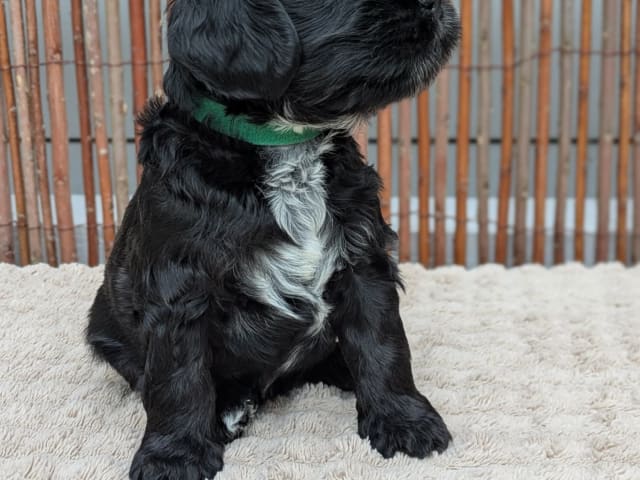
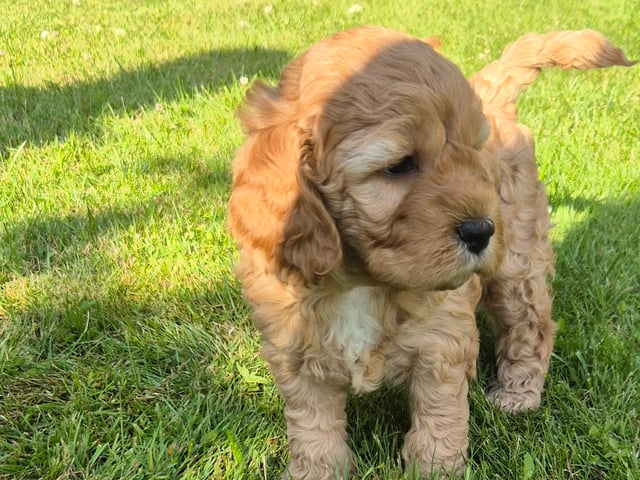
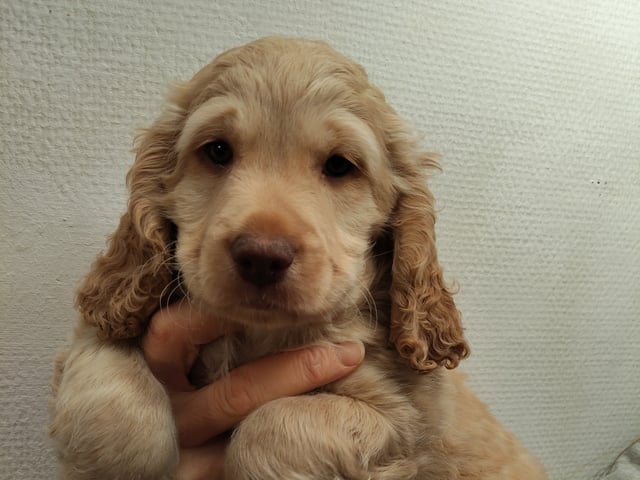
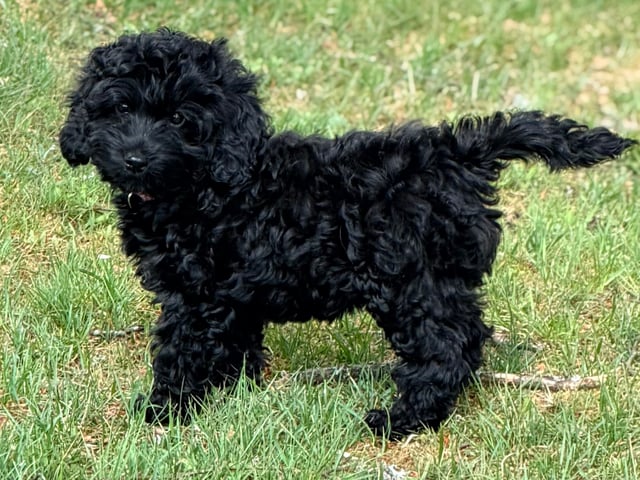
An adult Cockerpoo's size and coat cannot be predicted from one common set of measurements. Poodles come in four size varieties, while the Cocker line and inherited variation also affect the outcome. Ask the breeder which Cocker and Poodle variety were used, the parents' height and weight, and how adult full or half-siblings developed. This is more informative than generic measurements for the entire cross.
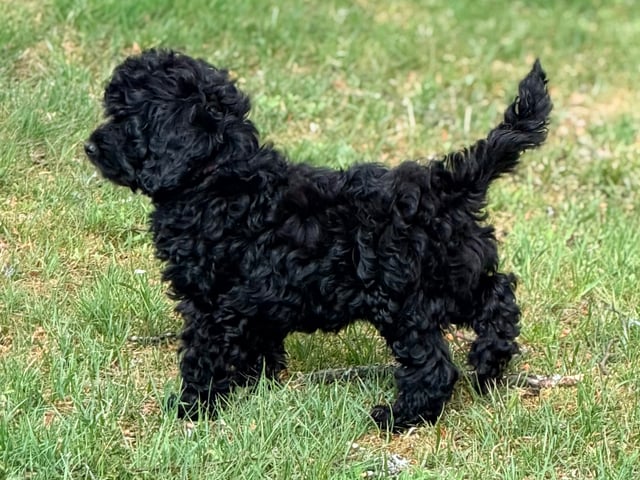
The coat may be relatively straight, wavy or curly. It may shed lightly, noticeably or somewhere in between, even among puppies in the same litter. Poodle crosses may shed less than many other dogs, but a curly coat is more prone to tangling, especially when wet. Low shedding therefore does not mean low maintenance.
Check the coat with both a brush and a comb all the way down to the skin. If the comb catches, tangles remain even when the surface looks well brushed. How often the dog needs brushing, bathing and clipping depends on the length and density of its actual coat and on everyday conditions, not on one fixed schedule for every Cockerpoo. Introduce a puppy calmly and early to having its paws, ears and face handled, as well as to a hair dryer and clippers.
Cockerpoos are not allergy-free. Dog allergens are found in substances including saliva and skin material, and the amount varies between individual dogs, even between littermates. Low shedding, a curly coat or an F1b label is therefore no guarantee that a person with allergies can live with the dog. Anyone with allergy symptoms should seek healthcare advice before buying a dog and assume that reactions may differ between individual dogs.

¶Temperament & Personality
A Cockerpoo may combine the Cocker Spaniel's liveliness and willingness to cooperate with the Poodle's activity and trainability, but the cross does not produce a predetermined temperament. Sociability, interest in chasing, noise sensitivity, ability to settle and reactions to handling can all vary. Environment, early experiences and training also matter greatly.
Be cautious of promises that every Cockerpoo is an easy first dog or an automatic fit for children. A British questionnaire study containing data on 9,402 dogs found several behavioural differences between common Poodle crosses and their parent breeds. It does not support the idea that the crosses generally require less training. The findings apply to groups and cannot predict an individual puppy, but they show why sales language should not replace a proper behavioural assessment.
Ideally, meet both parents, or at least the mother and other close adult relatives. Observe how they recover after an unexpected noise, approach people without becoming overbearing, cope with frustration and settle after activity. Ask specifically about barking, resource guarding, chasing, time alone, car travel and grooming. Answers describing real situations are more useful than labels such as “nice” or “family-friendly”.

¶Training & Exercise
Cockerpoos need daily movement, mental activity and recovery, but no minute-based rule suits every dog. The widely repeated five-minute rule for puppy exercise has no scientific support and should not be used as a strict schedule. Age, body size, health, fitness and recovery should determine the amount. A puppy needs short, varied activities and plenty of rest; an adult may enjoy walks, scent work, retrieving, problem-solving and other training with its owner.
Increase the workload gradually and look at the whole picture. Stiffness, reluctance to move, prolonged over-arousal or unusual tiredness after activity are reasons to reduce the demands and contact a vet when needed. A dog that keeps seeking activity may instead need help settling, better sleep or calm scent work, not automatically a longer and faster walk.
Prioritise these skills early:
- recall and engagement despite scents and movement in the surroundings
- walking calmly on a lead and a reliable stop or drop cue
- calm handling of the ears, paws, mouth and entire coat
- switching between activity and rest
- gradual alone-time training in very small steps
- comfortable car travel and neutral encounters with people and dogs
Use reward-based training and keep the level of difficulty manageable. Cocker ancestry may contribute an interest in scents, birds and movement, while Poodle ancestry is often associated with quick learning. Treat these as possible starting points, not guarantees. Recall needs to work around gradually increasing distractions before the dog is given more freedom.

¶Health
Cockerpoos are not automatically healthier than their parent breeds. Another study using owner-provided information compared three common Poodle crosses with their respective parent breeds. No statistically significant difference was found in 86.6 per cent of the comparisons. The result supports neither the claim that the crosses are generally healthier nor that they are generally less healthy. The data were collected at one point in time and describe groups, so they cannot serve as a prognosis for a particular puppy.
The practical safeguard is to assess both parents according to their own breeds and varieties. Ask for a registration number or other verifiable identity, the name of each test, the examination date and the actual result. “Vet checked” or “DNA tested” is not enough unless it is clear what was examined.
Check the Cocker parent
The puppy referral criteria used by the Swedish Cocker Spaniel Club include documented hip results, a current eye examination and a result for familial nephropathy, FN. These are criteria for the club's referral of purebred Cocker litters, not a formal set of rules for all Cockerpoo litters. They are nevertheless relevant checkpoints for the Cocker parent. Also ask about prcd-PRA, but remember that a prcd-PRA test covers only that specific form of PRA and does not rule out every retinal disease.
Check the Poodle parent
First establish the exact Poodle variety. In Sweden, Toy, Miniature and Medium Poodles have a health programme for prcd-PRA with recorded results, while Standard Poodles have a different breeding focus in which hip results are central. The Swedish Poodle Club also recommends a patellar examination before breeding Toy and Miniature Poodles. Check what is relevant to that parent's exact variety rather than accepting only that “the Poodle is tested”.
DNA results must also be interpreted as a combination. For an autosomal recessive disease, a healthy carrier can be used without producing affected puppies if the other parent is genetically clear of the same variant, but the test results for both parents must be verifiable. Ask a veterinarian or the relevant breed club to explain any result that is unclear.

¶History & Origins
Cockerpoos descend from two breeds with documented working histories. The Cocker Spaniel was developed in Britain as a flushing and retrieving gundog; its name is associated with hunting woodcock. The Poodle has an older European background as a water retriever. Both are now also kept as companions and for a wide range of activities.
The modern cross has become popular as a companion dog, but there is no shared standard that makes size, coat and other traits uniform. Claims about an exact first decade or one original breeding objective are poorly documented and should not be used to predict today's dogs. For an individual puppy, the parents' identities, working lines, health and behaviour matter far more than a simplified origin story.

¶Living with the Breed
Cockerpoos can live successfully in many kinds of homes when the individual's needs fit the household's routine. A flat is not an obstacle in itself, but the dog needs reliable routines for toilet breaks, activity and rest, plus training around sounds in stairwells and outside the door. Barking or anxiety is not solved by the size of the home; identify the triggering situations and train at a level where the dog can remain calm.
Time alone needs to be taught gradually. Start once the dog feels secure in the home, leave for a very short time and increase it only while the dog remains relaxed. If the dog barks, howls, destroys things, tries to escape or cannot eat when left, take the training back a step and assess the cause. Severe distress requires help from a veterinarian and a qualified behaviour professional.
An adult should always take responsibility for interactions with children. The dog needs a protected resting place, and children should not disturb it while it is sleeping, eating or trying to move away. Compatibility with cats or other dogs depends on the individuals. Introduce them gradually, use distance and physical separation, and prevent chasing before giving the animals more freedom together.
Before buying a puppy, you should be able to answer the following questions:
- Which Cocker line and Poodle variety were used, and how large are the parents?
- Which recorded health results are available for each parent, with dates and identities?
- How do the parents and adult relatives behave at rest, during handling, around noises, unfamiliar dogs and time alone?
- What are the coats of adult relatives like, and what care do they require in practice?
- How were the puppies raised and introduced to people, everyday sounds, surfaces, handling and brief periods of separation?
A sound assessment starts with documents and observable traits. Do not choose a Cockerpoo simply because it is described as allergy-friendly, easy or perfect for a family.
¶Characteristics
| Characteristic | Value |
|---|---|
| Breed Type | Crossbreed |
| Aggressiveness | 3/5 |
| Child Friendly | 3/5 |
| Energy | 3/5 |
| Hair Shedding | 3/5 |
| Health | 3/5 |
| Intelligence | 3/5 |
| Grooming Needs | 3/5 |
| Learning Ability | 3/5 |
| Barking Level | 3/5 |
| Height | 0 – 0 cm |
| Weight | 0 – 0 kg |
| Life Expectancy | 0 – 0 years |
¶Cockerpoo price
Here you can see typical asking prices for Cockerpoo in Sweden over the last 12 months.
The calculation is based on valid Get a Pet listings from the last 12 months, including active and expired listings. These are asking prices, not confirmed sale prices.
¶Frequently Asked Questions
Are Cockerpoos good family dogs and how do they behave with children?
They are typically affectionate, people focused and playful, which suits many families. Most enjoy children if they are well socialized and the kids are taught to handle dogs respectfully. Because they can be excitable and sensitive, supervision and calm handling are important, especially around very young children.
How much exercise does a Cockerpoo really need each day?
Despite their often small size, they are usually energetic and need more than just a short walk. Most do best with at least 60 to 90 minutes of varied activity daily, including walks, play and some mental enrichment. If their working spaniel and poodle instincts are strong, they may need even more structured exercise and training to stay settled indoors.
Do Cockerpoos shed and are they truly hypoallergenic?
Shedding varies, because some inherit more of the cocker coat and others more of the poodle coat. Many shed lightly, but few are completely non shedding, and no dog is guaranteed hypoallergenic. People with allergies should meet the individual dog several times before committing, and be prepared for regular grooming to reduce loose hair and dander.
What kind of grooming and coat care does a Cockerpoo need?
Their coat can be straight, wavy or curly, but almost all need frequent brushing to prevent mats, especially around the ears, armpits and tail. Most require professional grooming every 6 to 10 weeks for clipping and tidying. Regular ear checks, nail trims and teeth brushing are also important, as floppy ears and small mouths can be prone to issues.
What health problems are Cockerpoos prone to?
Common concerns include ear infections, allergies and eye conditions such as cataracts or progressive retinal atrophy. They may also inherit joint issues like hip dysplasia or patella luxation and some are prone to dental disease. Responsible breeders screen parent dogs and owners can reduce risk with good ear care, weight control and routine veterinary checks.
Are Cockerpoos prone to separation anxiety and clingy behavior?
They tend to bond closely with their families and often dislike being left alone for long periods. Without gradual training to cope with solitude, some can develop barking, destructive behavior or anxiety. Early practice with short absences, plenty of mental enrichment and realistic expectations about time at home are important for this mix.
How big do Cockerpoos get and what affects their adult size?
Adult size depends largely on whether the poodle parent was toy, miniature or occasionally standard, and on the specific cocker spaniel lines. Most fall somewhere in the small to medium range, but there can be significant variation even within the same litter. Asking for the parents’ sizes and growth information can give a more accurate expectation.
Are Cockerpoos easy to train for first time dog owners?
They are usually intelligent, eager to please and food motivated, which helps training. However, some can be sensitive or easily distracted, particularly if they inherit more spaniel enthusiasm or poodle sharpness. Consistent, reward based methods and plenty of short, positive sessions work best, and first time owners may benefit from a structured puppy class.
Is a Cockerpoo suitable for apartment living or small homes?
They can adapt well to smaller spaces as long as their exercise and mental needs are reliably met. They are often quite vocal and alert, so sound sensitivity in neighbors can be a factor. Daily outdoor activity, training to manage barking and indoor enrichment are key for a harmonious apartment life.
What should I know about Cockerpoo ears and how to care for them?
Their long, floppy ears and often dense ear hair can trap moisture and reduce air circulation, which raises the risk of infections. Regular checks, gentle cleaning as advised by a vet and keeping ear hair trimmed by a groomer can help prevent problems. Owners should watch for redness, odor or head shaking and seek veterinary advice promptly if these appear.
¶Comparisons with other breeds
Compare Cockerpoo with other breeds and see the differences in temperament, activity level, and care to make a confident choice. Show all comparisons