
¶Table of Contents
¶Quick Facts
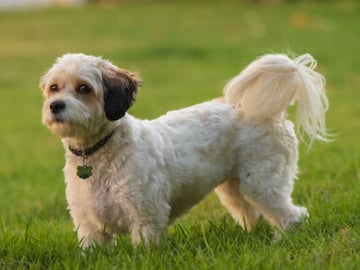
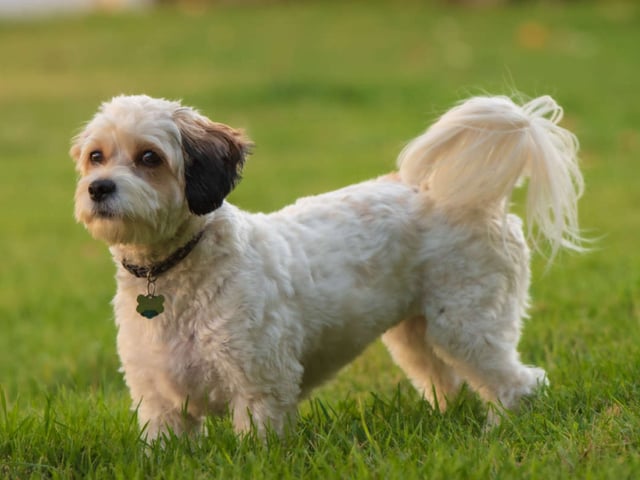
The Cavachon is a cross between a Cavalier King Charles Spaniel and a Bichon Frisé. There is no shared official breed standard, so the name identifies the breeds in its background but does not guarantee a particular size, coat or personality.
- A Cavachon is usually a small companion dog, but its likely adult size should be judged from both parents and adult relatives.
- The coat may range from soft and gently wavy to denser and curlier. Shedding and the need for clipping also vary.
- Both parent breeds were developed for companionship. An individual Cavachon may nevertheless be lively, sensitive to noise, reserved or intensely people-focused.
- Expect to provide daily physical activity, scent work or other mental exercise, and regular coat care.
- No dog is allergen-free. Low shedding does not reveal how much allergen an individual dog produces.
- When choosing a puppy, documented health screening for both parent breeds matters more than claims that the cross itself must be healthier.
Meet the puppy’s mother, establish which generations lie behind the litter, and look at health, temperament, coat and adult size among close relatives.
¶Appearance & Coat
A Cavachon will normally be a small dog, but there is no official Cavachon range for height or weight. For reference, the Cavalier King Charles Spaniel standard gives a weight of 5.5–8 kg, and the breed is commonly 30–35 cm tall. The Bichon Frisé has an ideal height of 25–29 cm and weighs about 5 kg. Parents outside these reference points, a backcross to either breed, or a Cavachon-to-Cavachon litter may produce a different result. Look at the actual parents and their adult offspring instead of relying on a size label.
Nor can the coat be described by a single template. The Cavalier has a long, silky coat without curls, although a slight wave is allowed. The Bichon Frisé has an abundant coat of loose corkscrew curls with a soft, dense undercoat. A Cavachon may have straighter or wavier feathering, tighter curls, more or less undercoat, and varying degrees of shedding. Colours and markings may reflect the Cavalier’s four colour varieties or the Bichon’s white coat, but no colour is more correct for a Cavachon.
Care depends on the individual coat. Work a comb from the skin outwards and check particularly behind the ears, in the armpits, on the legs, and wherever a harness or collar rubs. If the comb catches, the coat needs more frequent detangling or a shorter trim. A dense, curly coat may need frequent combing and regular clipping; a more Cavalier-like coat may shed more and require a different routine. Introduce the puppy gradually to combing, paw handling, bathing and drying. Mats must be prevented and removed before they affect the skin or movement.
Low shedding is not the same as a low allergy risk. Dog allergens are found in sources including saliva and skin, and levels vary between individual dogs, even within the same litter. Anyone with a dog allergy should not choose a Cavachon on the strength of the word ‘hypoallergenic’ or a puppy’s coat type.
¶Temperament & Personality
A Cavachon may become a sociable and affectionate companion, but temperament must be assessed in the individual dog and its family. The Cavalier breed ideal describes a happy, friendly and fearless dog. The Bichon Frisé should be happy, playful, adaptable and sociable with people and dogs. An open, people-oriented nature is therefore a reasonable hope, but there is no Cavachon behaviour standard. Two puppies in one litter may respond differently to noise, unfamiliar people, handling and time alone.
Ask how the mother and father behave in everyday life, not only during a brief visit. Can they settle when nothing is happening? How do they respond to sounds at the door, unfamiliar people and passing dogs? Have close relatives shown intense fear, persistent barking or difficulty being left? A single puppy assessment cannot guarantee the adult dog’s personality.
Suitability for children does not come automatically with the name. A small dog can be injured by being dropped, carried incorrectly or caught in rough play. Children and dogs need calm contact under active adult supervision, and the dog needs a private resting place. Children should leave it alone when it is sleeping, eating or trying to move away.
The same care applies to other animals. Previous experience, chasing and play behaviour, and the other animal’s confidence matter more than the label. Make introductions gradually, prevent chasing, and give a cat clear escape routes and high resting places. Do not leave the animals alone together until their interactions have remained calm over time.
¶Training & Exercise
A Cavachon needs physical and mental activity every day, but a fixed number of exercise minutes will not suit every dog. Age, health, build, fitness and personality determine the right level. A good routine for a healthy adult combines walks, time to sniff, play, short training sessions and opportunities to join family activities. Puppies need shorter, varied experiences and plenty of rest; increase exercise gradually as the dog matures.
Reward-based methods work for both practical skills and enrichment. Train in small steps and reward engagement, recall, walking on a loose lead and settling in a chosen place. Increase the difficulty only when the dog succeeds in the easier setting. Scent games, searching for food and tricks provide mental exercise without every activity having to be long or physically demanding.
House training, a safe recall and relaxed time alone are learned skills; they are not inherited from the parent breeds’ reputations. Give a puppy frequent opportunities to toilet and reward the right choice. Practise recall on a long line or in an enclosed space before allowing freedom where failure could be dangerous. If the dog alerts to sounds in a communal hallway, create distance from the door, reward calm behaviour and practise with quiet sounds before making the task harder.
Time alone is built from very short periods when the dog is secure and relaxed. A young puppy cannot be left alone, while a well-prepared adult can usually manage a few hours. Do not extend the time if the dog paces, pants, barks or tries to escape. The Swedish Board of Agriculture’s advice to take a dog out at least every six hours during the day concerns outdoor access; it is not a target for how long a dog should be left alone.
¶Health
A Cavachon may develop health problems found in either parent breed. Having parents from two different breeds is not a health certificate and does not remove the need for screening. Research into other common designer crosses has not demonstrated a general health advantage over their parent breeds; the study did not include Cavachons and therefore cannot establish disease rates for this cross. The practical conclusion is to assess each parent according to its own breed and family history.
For the Cavalier parent, the heart is a central checkpoint. In Sweden, the breed has an official health programme for myxomatous mitral valve disease. A valid certificate showing no heart murmur must be issued after three years of age and be no more than twelve months old at mating. If the dog is used before five years of age, both of its parents must also have heart-clear certificates from examinations performed after they turned five. Ask to see the actual result and find out when close relatives first developed a murmur. Check the registered result from the breed’s breathing assessment as well. Syringomyelia occurs in Cavaliers and can cause severe pain, so ask how the breeder evaluates symptoms and disease history in the family.
For the Bichon Frisé, the Swedish breed club recommends that breeding dogs have an eye examination certificate no more than twelve months old at mating. Every breeding dog should have a known patellar status, with grade 0 in both parents as the main rule. Ask to see registered results rather than accepting a verbal assurance that a dog has been ‘tested’. Also ask about recurring itchy skin, allergies and eye problems in parents and close relatives, as these occur in the breed.
The results must be considered together. A DNA test does not replace a heart examination, patellar assessment, eye examination, breathing assessment or knowledge of relatives’ health. Ask the breeder to explain why the parents were chosen and how previous offspring have been followed up. Walk away if documentation is missing or the sales pitch rests on mixed-breed dogs being automatically healthier.
¶History & Origins
Cavachon is a modern name for a cross between two older companion breeds. Breed guides often repeat an exact starting year, a particular founder and a single country of origin, but no official stud book documents one shared foundation history. Those details should not be treated as established fact.
The histories of the parent breeds are better documented. Small spaniels have appeared in European art for centuries. The modern Cavalier King Charles Spaniel was shaped in Britain and recognised as a separate breed in 1945. The Bichon Frisé has a Franco-Belgian standard and descends from small bichon-type dogs that became popular at European courts; its first standard was adopted in 1933.
Crossing these breeds does not create a new official standard. A first-generation Cavachon has one parent of each breed. Other litters may come from a Cavachon and one parent breed, or from two Cavachons. The name alone is therefore not enough to establish a particular dog’s genetic background. Ask for a clear pedigree or equivalent parentage records covering every generation the breeder claims is behind the puppy.
¶Living with the Breed
A Cavachon is best suited to someone who wants to live closely with a small companion dog and can accommodate variation. A small home can work, but floor space does not replace walks, training, rest and gradual preparation for time alone. In a flat, the dog’s response to communal sounds and ability to settle matter more than its size.
Make a realistic check of your everyday life before buying:
- Is there time for daily activity, short training sessions and coat care tailored to this dog’s coat?
- Can someone stay at home during puppyhood and build time alone slowly without pushing past clear signs of stress?
- Can children follow rules for gentle handling, with an adult always supervising contact?
- If there are other animals, can you provide separate areas and a gradual introduction?
- Has the breeder shown identification, parentage and relevant original results for both parents?
- Have you seen the mother with her puppies and gained a clear picture of how the parents and adult relatives behave in everyday life?
A Swedish-born puppy may leave its mother no earlier than eight weeks of age and must have been examined by a vet no more than seven days before purchase. Check the contract, identity and documents before deciding. A responsible seller can answer difficult questions clearly and does not promise an allergen-free coat, a fixed adult appearance or a problem-free temperament.
In the right home, a Cavachon can become an engaged companion. What matters is whether the actual dog’s needs, family background and everyday behaviour fit the life you can offer for many years.
¶Characteristics
| Characteristic | Value |
|---|---|
| Breed Type | Crossbreed |
| Aggressiveness | 3/5 |
| Child Friendly | 3/5 |
| Energy | 3/5 |
| Hair Shedding | 3/5 |
| Health | 3/5 |
| Intelligence | 3/5 |
| Grooming Needs | 3/5 |
| Learning Ability | 3/5 |
| Barking Level | 3/5 |
| Height | 0 – 0 cm |
| Weight | 0 – 0 kg |
| Life Expectancy | 0 – 0 years |
¶Frequently Asked Questions
What kind of temperament does a Cavachon typically have?
This crossbreed is usually affectionate, sociable, and people oriented, often inheriting the gentle nature of the Cavalier and the cheerful energy of the Bichon. Most are good with children and other pets, but they can be sensitive and do best in homes that offer plenty of companionship and calm handling.
Are Cavachons really hypoallergenic and do they shed much?
Many individuals shed very lightly because of the Bichon influence, but no dog is truly hypoallergenic. Coats can vary within a litter, so some will shed more than others and allergy sufferers should spend time with adult dogs of similar parentage before committing.
How big do Cavachons get and are they suitable for apartments?
Most adults weigh around 12 to 20 pounds and have a compact, moderate build. Their small size and generally calm indoor demeanor can work well in apartments as long as they receive daily walks, some playtime, and are not left alone for long periods.
What health problems are Cavachons prone to from their Cavalier and Bichon heritage?
They can inherit issues seen in Cavaliers such as heart disease, especially mitral valve disease, and eye or joint problems. From the Bichon side there is some risk of allergies, skin problems, and bladder stones, so regular veterinary checks and monitoring for early signs are important.
How much exercise does a Cavachon actually need each day?
Most do well with about 30 to 60 minutes of activity per day, split between walks and short play sessions. They are usually more about companionship than intense sport, but they benefit from mental stimulation such as training games and gentle scent or puzzle activities.
What kind of grooming routine does a Cavachon coat require?
Their soft, often wavy coat can mat if neglected, so brushing several times a week is usually needed, along with professional grooming every 6 to 8 weeks. Regular ear cleaning, tear stain management, and trimming around the eyes are also common needs for this crossbreed.
Do Cavachons bark a lot or tend to develop separation anxiety?
Many are quite attached to their owners and can become vocal or distressed if left alone frequently for long hours. Early training, gradual alone-time practice, and providing mental enrichment can help reduce nuisance barking and prevent anxiety from developing.
Are Cavachons good with children and first-time dog owners?
Their gentle and friendly nature usually makes them a good match for families with respectful children and for beginners. However, their small size means they can be easily injured by rough handling, so supervision and teaching children appropriate interaction are essential.
How trainable are Cavachons and are they difficult to housebreak?
They tend to be eager to please and respond well to calm, reward-based training, although some can be a little soft or easily distracted. House training can take patience, as with many small breeds, so a consistent schedule, frequent outdoor trips, and crate training are often helpful.
What is the typical lifespan of a Cavachon and how can I help them live longer?
The average lifespan is often around 12 to 15 years, reflecting their small size and mixed heritage. Keeping them at a healthy weight, maintaining good dental care, providing regular exercise, and having routine veterinary checks can support a longer, healthier life.
¶Comparisons with other breeds
Compare Cavachon with other breeds and see the differences in temperament, activity level, and care to make a confident choice. Show all comparisons