¶The safest kitten purchase starts before the deposit
It’s easy to let the process start with the photo in the ad. A tiny kitten sitting in a window, a color you instantly like, a litter that happens to be nearby, and a pickup date that fits your vacation plans. But the safest purchase starts earlier than that: with age, living conditions, paperwork, and a seller who can calmly answer specific questions.
For a buyer, this isn’t just administration. The documents that come with a kitten say something about how the litter was planned, how carefully its health has been monitored, and whether the handover is happening on the kitten’s terms. A serious seller shouldn’t see these questions as distrustful. They’re part of buying an animal responsibly.
That’s why this guide focuses on the practical question many people ask first as pickup day approaches: when is a kitten actually ready to move, and what should be in place before it does?
¶Twelve weeks is a minimum, not an automatic green light
In Sweden, 12 weeks is the clear minimum age for a normal handover. The Swedish Board of Agriculture states that kittens must not be separated from their mother until they are ready and at least 12 weeks old. If, for special reasons, a kitten is to be delivered slightly earlier, the Board of Agriculture requires, among other things, a veterinary health assessment, that the kitten has fully transitioned to solid food, and that it is mature enough. As a buyer, this means such an arrangement should never rest on a promise in an ad alone, but on clear documentation.
That distinction matters. A kitten may have reached 12 weeks and still be small, cautious, recovering from illness, or simply need more time with the litter. If the seller insists from the start on pickup taking place exactly on the day the kitten turns 12 weeks, without wanting to discuss the individual kitten’s maturity, it’s reasonable to ask follow-up questions.
Look for practical signs. Is the kitten eating on its own without problems? Is it using the litter box? Does it move around the home confidently? Does it still search intensely for its mother when she leaves, or can it handle short separations without panicking? A few cries or signs of unease don’t tell the whole story, but a kitten that is clearly not independent should not be rushed off just because the calendar says it can go.
For purebred cats, breed association rules often apply on top of the legal minimum. Under SVERAK, the main rule has been that a kitten must be at least 14 weeks old at delivery. Since 2023, delivery from 12 weeks is possible, but only if a veterinarian has approved it on SVERAK’s inspection form. Without that approval, the 14-week rule applies. For buyers, this means the question of age should be answered clearly, not vaguely.
¶Ask to see the environment the kitten grew up in, not just the kitten
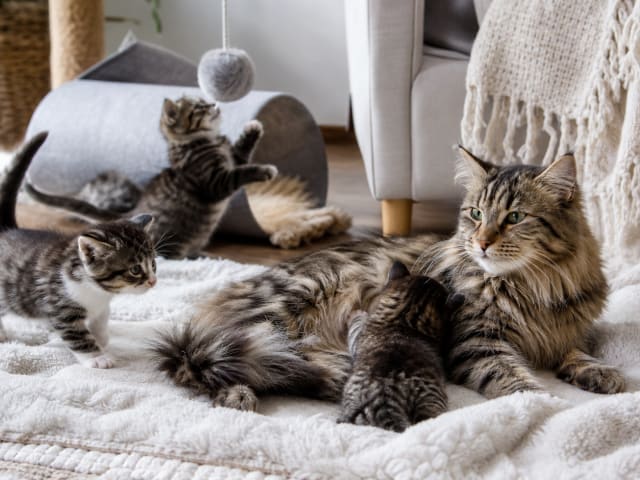
A kitten is never bought without context. It comes from an environment where it has learned about people, sounds, smells, handling, and everyday routines. That’s why it’s wise to meet the kitten in the seller’s home when possible, or at least get a clear video tour of the environment if distance makes an initial visit difficult.
What matters is not whether the home looks perfect. What matters is that it seems safe, clean, and reasonably set up for kittens. Is the mother there? Do the kittens seem alert and appropriately curious? Do they get to move around in a home environment, or are they mostly kept hidden away? Is there food, water, a litter box, a sleeping area, and room to play without everything feeling chaotic?
Also ask how the kittens are handled in daily life. Have they met different people? Are they used to normal household sounds? Have they had the chance to climb, play, be picked up briefly, and be gently examined? A well-socialized kitten is not necessarily fearless in every situation, but it has had many small opportunities to discover the world in a controlled way.
If the seller doesn’t want to show the mother, can’t explain why she’s missing, or wants to meet in a parking lot without a reasonable explanation, it’s best to hold off. Sometimes there are legitimate reasons for unusual arrangements, but they should be explained openly. Secrecy is rarely a good sign when an animal is changing homes.
¶The documents that should be ready at pickup
There’s a simple rule of thumb: the more the seller wants to keep things verbal, the more cautious you should be. A safe kitten purchase should leave a paper trail. That doesn’t mean every kitten must be purebred or come from a large breeder, but there should be clear documents covering identity, health, payment, and responsibility.
Ask for a written sales agreement. It should include the seller, buyer, the cat’s identity, date of birth, sex, color or identifying features, price, payment terms, delivery date, and what is included. If the cat is ID-marked, the microchip number or tattoo should be listed. If it is a purebred cat, details of the pedigree or registration certificate should be clearly stated.
Ask for a veterinary inspection certificate. For SVERAK breeders, a current veterinary certificate is part of the transfer, and SVERAK states that the certificate is valid for no more than seven days. Even outside SVERAK, a recent veterinary certificate is a strong sign of security. It does not prove that the cat can never become ill, but it provides an independent health check close to the delivery date.
Ask for a vaccination certificate. Kittens are normally vaccinated according to a schedule, and what matters for you as a buyer is knowing what has been done, which vaccine was given, and when the next dose or booster is due. Feline panleukopenia is a serious disease for which vaccination is recommended for all cats and kittens in Sweden, and cat flu is especially relevant in environments where cats are kept in groups. If anything in the vaccination plan differs from the norm, the seller should be able to explain why and refer to veterinary advice.
Also ask about deworming, insurance, and food. Not all kittens need the same deworming schedule, since the risk depends on the environment and the mother, but the seller should be able to say what has been done and why. If the seller has hidden defect insurance or any other breeder-related insurance, you should be told what it covers and what it does not cover. You should also arrange your own cat insurance well in advance, so you know when coverage begins and whether there is a waiting period.
¶ID marking and registration: check the change of ownership right away
In Sweden, cats must be ID-marked and registered with the Swedish Board of Agriculture before they are four months old. If you buy or take over a cat that is over three months old, you must make sure it is or becomes ID-marked and register yourself as the owner within four weeks. This requirement also applies to indoor cats.
That makes the microchip number important from the moment you pick the kitten up. Ask the seller to show you which number belongs to the kitten and check that the same number appears in the paperwork. A veterinarian can scan the chip if you’re unsure. If the cat is already registered, the ownership transfer needs to be done correctly; if it isn’t registered, you need to arrange that according to the rules.
Registration in a voluntary register can be useful, but it does not replace the Swedish Board of Agriculture’s cat register. For purebred cats, the cat may also be registered in a breed association registry and have a pedigree. These are separate systems with different purposes. As a buyer, you therefore need to keep three things apart: the cat’s ID marking, the Swedish Board of Agriculture’s ownership registration, and any pedigree or breed association registration.
¶SVERAK, pedigree, and purebred cats: what should you expect?
If you buy a purebred cat from a SVERAK breeder, the framework is clearer than in many private sales of non-pedigree cats. According to SVERAK’s information, the cat must be ID-marked, fully vaccinated according to the rules, veterinary inspected, and accompanied by a pedigree or a certificate confirming that the pedigree is being processed. The breeder must also use a written contract.
That doesn’t mean all good cats have to be purebred. Nor does it mean a SVERAK breeder is automatically the right choice for you. But breed association rules make it easier to know what should come with the cat and what requirements the seller has agreed to follow.
Pay close attention to phrases like “purebred without pedigree.” In practice, a cat sold as purebred should be supported by proper registration. Without a pedigree, you are not buying a documented purebred cat, even if the kitten resembles a certain breed. It can still be a wonderful cat, but the price, expectations, and contract should reflect what can actually be documented.
Also ask about breed-specific health programs or tests. Different breeds have different risk areas. A serious breeder should be able to explain what has been checked in the parent cats, what the results mean, and what cannot be guaranteed. Here, a clear and calm answer is worth more than long promises.
¶Your rights as a buyer: private seller or breeder?
A buyer’s rights depend on who is selling the cat. The Swedish Consumer Agency distinguishes between buying from a private individual and buying from a breeder or business. In a private sale, what you have agreed on takes precedence, and if the agreement is unclear, the Sale of Goods Act applies. If the seller is operating as a business, the Consumer Sales Act may be relevant.
As a buyer, you do not need to determine every legal boundary on the spot, but you should make sure the agreement is clear. Who is selling the cat? Is the seller a private individual, breeder, or company? What happens if the cat turns out to be ill shortly after the purchase? What has the seller said about the cat’s health, vaccination, behavior, breed, registration, and insurance?
Save written communication. Not to create conflict, but to avoid misunderstandings. If something later needs to be sorted out, it is much easier when the details about price, pickup, health, and terms are in writing.
Be cautious with terms that sound far-reaching but remain vague. A seller may want to stay in touch, receive updates, or include recommendations about neutering and outdoor access. That can be reasonable. But if the contract contains conditions that affect your ownership rights, future decisions, or your right to rehome the cat, read carefully and ask questions before signing.
¶Warning signs in ads and communication
An irresponsible sale does not always look obvious at first. Sometimes the photos are lovely, the tone is friendly, and the price seems reasonable. That’s why it’s better to look for patterns than individual details.
Be cautious if the kitten is offered too early, if the date of birth is missing, or if the seller says “it eats on its own, so it can move now” even though it is under 12 weeks old. A kitten eating solid food is not the same as being ready to leave its mother.
Also be cautious if the seller cannot show the mother or the litter’s environment, if several litters and many different kinds of cats are being sold at the same time without a clear explanation, or if the seller changes their story when you ask about age, vaccination, or ID marking.
Financial arrangements can also be a warning sign. A deposit is not unusual, but it should be reasonable, receipted, and tied to a clear agreement stating what happens if the sale does not go through. Full payment long before pickup, especially to someone you haven’t met and where the kitten cannot be clearly identified, carries greater risk.
Pressure is another warning sign. “Decide now or the cat goes to someone else” is a poor basis for a decision when you are taking responsibility for an animal for many years. A serious seller also wants to know who you are, how the cat will live, and whether you have thought through everyday life with it.
¶The questions that reveal the most
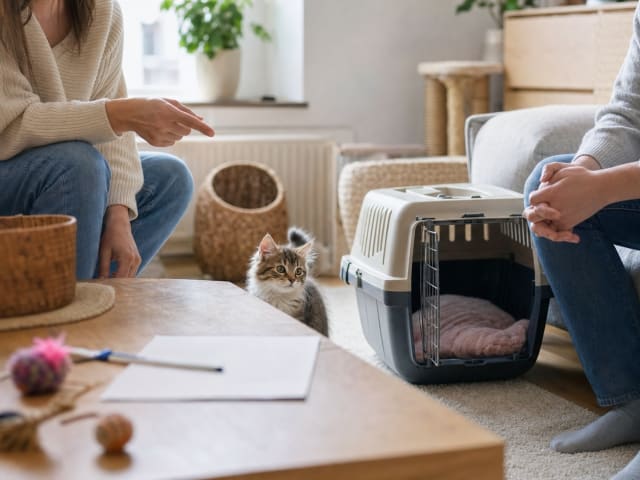
You don’t need to interrogate the seller. But a few calm, concrete questions usually show quickly whether the person has followed the kittens closely.
Ask what date the kitten was born and the earliest date it can move. Ask how the seller assesses whether this particular kitten is ready, not just the litter as a whole. Ask what it eats, how litter training is going, and whether it has had any symptoms such as diarrhea, sneezing, runny eyes, coughing, itching, or limping.
Ask which vaccinations have been given and when the next one should be administered. Also find out whether the veterinary inspection has been booked and how recent the certificate will be on delivery day. Ask about ID marking and registration. Ask what will be included at pickup: contract, certificates, vaccination card, food, information about routines, and any insurance details.
Ask the seller to describe how the kitten behaves with people and other cats. Is it outgoing, cautious, very active, or more quiet? Are its siblings very different from one another? A seller who can describe the individuals in detail has often genuinely observed them. A seller who only says they are all “super sweet and perfect” gives you much less to go on.
¶Plan the pickup so the kitten gets a gentle landing
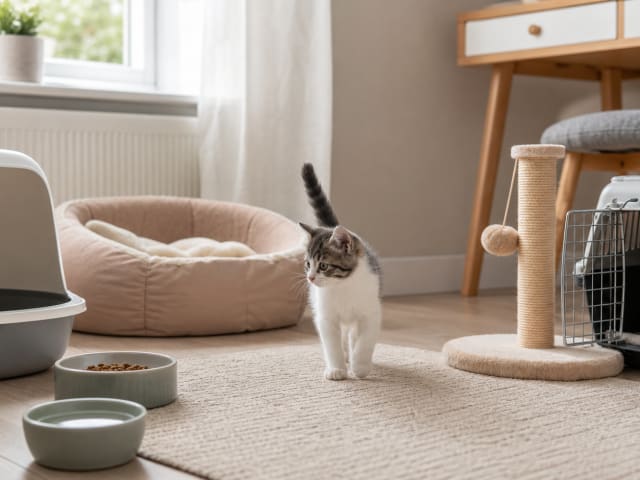
When everything looks good and pickup day is approaching, it’s easy to think the difficult part is over. For the kitten, however, the move is a major change: smells, sounds, people, rooms, feeding spots, and sleeping places all change at once. A safe pickup is therefore about both paperwork and practical care.
Use a secure carrier, not your arms or a loose cardboard box. If possible, place a blanket or towel inside that carries the scent of the kitten’s previous home, if the seller can provide one. Plan the trip so it is as short and calm as possible. Avoid errands on the way and never leave the kitten alone in the car.
At home, the kitten should start out in a smaller, prepared room. It should have a litter box, water, food, a sleeping place, a scratching area, and a hiding spot. Limiting the space at first is not a punishment; it is a way to make the new world easier to understand. Once the kitten is eating, using the litter box, and seems comfortable, you can gradually open up more parts of the home.
Don’t change everything at once. It is often best to use the same food at first and make any food changes gradually. Keep visits, handling, and play at a level the kitten can cope with. Children need clear rules: let the kitten come forward on its own, don’t disturb it when it is sleeping, and don’t carry it around unnecessarily.
¶When should you contact a veterinarian?
A veterinary certificate at the time of purchase is a snapshot, not a guarantee. Kittens can become ill quickly, and the stress of moving can make symptoms more noticeable. That’s why it’s a good idea to know, before pickup, which veterinarian you can contact.
Seek veterinary care if the kitten is lethargic, not eating, vomiting repeatedly, has diarrhea that does not pass quickly, develops watery or pus-filled eyes, is breathing with effort, is limping, seems to be in pain, or is unable to urinate. Also contact a veterinarian if you suspect the kitten has ingested something unsuitable. If you are unsure, it is better to call once too often than once too little.
If you notice symptoms immediately after the purchase, you should both care for the kitten and document things factually. Keep certificates, photos if needed, the veterinarian’s assessment, and your communication with the seller. The kitten’s health always comes first, but having the documentation in order makes things easier if responsibility later needs to be clarified.
¶Quick checklist before pickup
Before agreeing on a delivery date, you should be able to answer yes to the essentials:
- The kitten is at least 12 weeks old, or meets the relevant breed association rules.
- The kitten eats solid food, uses the litter box, and seems mature enough to leave its mother.
- You have seen the kitten in a reasonable upbringing environment.
- There is a written contract with clear details about the cat, seller, buyer, price, and delivery.
- Veterinary inspection, vaccinations, and ID marking are completed or clearly planned.
- If the cat is being sold as purebred, there is a pedigree or breed association certificate.
- You know what insurance applies and when your own coverage begins.
- You have prepared a carrier, the first room, food, a litter box, and veterinary contact.
If several of these points are missing, it is wise to pause. It may feel difficult to say no to a kitten you already like, but a safe kitten purchase should stand up to a second thought. A seller who truly wants what is best for the kitten also wants the move to be handled properly from the start.
¶A good purchase feels calm, even when it’s emotional
Picking up a kitten will always be emotional. It should be. But emotion should not have to replace order. On the contrary, it is often good organization that allows joy to take its place without anxiety in the background.
When age, health, ID marking, the contract, and practical routines are all clear, both buyer and seller know where they stand. The kitten gets a better start, the seller shows responsibility for the litter, and you begin life as a cat owner with the right expectations.
That is where a safe kitten purchase begins: not with the cutest photo, but with a move that happens when the kitten is ready and all the important pieces are in place.