

¶Fewer Dogs Registered in Sweden
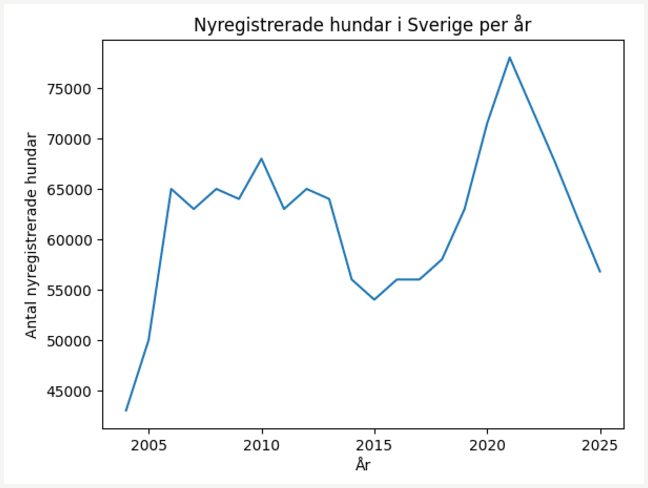
In 2025, the number of newly registered dogs in Sweden continued to decline. According to statistics from the Swedish Board of Agriculture (Jordbruksverket), 56,801 dogs were newly registered during the year, the lowest level in eight years.
Source: Swedish Board of Agriculture: Lowest number of newly registered dogs in eight years
It’s important to put these figures into context. During the pandemic years, demand for dogs rose sharply when more people worked from home and had greater opportunities to take responsibility for a dog in their everyday life. Those levels were unusually high and difficult to sustain over time. What we’re seeing now is better described as a return to more long-term sustainable levels.
Similar patterns can be seen across the rest of the Nordic region. In Denmark, figures from the Danish Dog Register (Dansk Hunderegister) show that the number of new registrations has decreased in recent years, with 53,054 dogs registered in 2025 in their report.
Source: Dansk Hunderegister: Nøgletal
In Finland, the Finnish Kennel Club (Suomen Kennelliitto) reports that the number of registered dogs continued to fall in 2025, with 37,538 dogs registered during the year.
Source: Suomen Kennelliitto: Kennelliiton rekisteriin ilmoitettiin 37 538 koiraa vuonna 2025
In Norway, the Norwegian Kennel Club (Norsk Kennel Klub) describes registrations in 2025 as stable and in line with an established pattern, with few major changes at the top.
Source: Norsk Kennel Klub: Hunden holder stand – stabile registreringstall i 2025
Taken together, this points to a Nordic dog market characterized more by careful consideration than rapid growth. Fewer new registrations do not mean that interest in getting a dog has disappeared. Rather, it may indicate that buying behavior has changed. To understand how, you need to look beyond registration statistics and instead follow how people search for information, compare options, and make decisions before buying a dog.
¶How Many Dogs Are There in Sweden Today?
To understand developments in the dog market, you need to start with the official figures. According to the Swedish Board of Agriculture, there are currently just over one million registered dogs in Sweden. In 2025, around 57,000 dogs were newly registered, roughly ten percent fewer than the year before and the lowest level in eight years.
Source: Swedish Board of Agriculture – Lowest number of newly registered dogs in eight years
These figures clearly show that fewer new dogs are added each year. At the same time, they say relatively little about what demand actually looks like. The number of dogs in the country changes slowly and is influenced by many factors, such as life expectancy, household finances, and how people choose to live their lives.
It is also important to distinguish between the number of completed purchases and the interest in buying a dog. Our experience is that these two measures do not always move in the same direction. Even in periods with fewer new registrations, engagement can remain high, but take the form of longer decision processes and greater caution before buying.
To understand how the dog market really works in 2025, you therefore need to complement the official statistics with behavioral data that shows how people search for information, compare options, and prepare for a potential dog purchase.
¶A New Buying Behavior Is Taking Shape
When we analyze behavioral data from Get a Pet, we see clear signs that the way people approach buying a dog has changed. Even though fewer dogs are registered overall, engagement among potential buyers has not decreased to the same extent.
In 2025, the number of active alerts (saved searches) increased compared with 2024. Overall, the level was about 15 percent higher over the year, with particularly strong increases in the autumn months. This indicates that more people choose to follow the market over a longer period instead of making quick decisions.
At the same time, we see that the decision process has become more drawn out. More and more users create multiple alerts or adjust their criteria over time, rather than moving straight to making contact. Compared to the pandemic years 2020 to 2022, when many purchases were carried out quickly, today’s behavior is marked by greater caution and more active information gathering.
Our data also shows that openness is common in the early stages. Around 94 percent of alerts during the period were created without being limited to a specific pedigree breed. This suggests that many people primarily look for a dog that fits their lifestyle, rather than starting from a predetermined breed choice.
Taken together, this suggests that the 2025 dog market is not characterized by lower interest, but by higher expectations. For many, it is no longer about finding a dog as quickly as possible, but about making a more considered decision that will work over time.
¶Many Start Broad and Narrow Down Later
When we analyze how searches and alerts are created on Get a Pet, we see that many buyers begin their process without locking in a specific breed choice. On the contrary, it is common to start with broad criteria and only later narrow down their selection.
In 2025, a clear majority of alerts were created with broad preferences. Around 94 percent of alerts either included mixed-breed dogs or did not specify a breed at all. This suggests that breed is often not the starting point for the purchase, but something that emerges later in the process.
Instead, we see that other factors are prioritized early on. Size, age, and geographic proximity are common criteria in the initial stage. Only over time, as buyers learn more about different options, do many start adjusting their alerts and becoming more specific in their choices.
This behavior can be seen as an expression of increased awareness. By not locking in too early, buyers leave room to compare more options and to make a more well-founded decision. Our data indicates that buyers today are more likely to start from their own life situation and everyday reality, rather than from a predetermined breed.
All in all, this points to a more methodical and long-term buying behavior. For many, the goal is not to find a specific breed as quickly as possible, but to find a dog that fits the life they actually live.
¶The 2025 Dog Buyer Is Older and More Established
Looking at the age distribution among active users on Get a Pet, a clear picture emerges of who today’s dog buyer is. The 2025 dog buyer is on average older than in previous years and often in a more established phase of life.
The average age of users is just over 45. Around three-quarters of buyers are 35 or older, and the single largest group is people over 55. At the same time, people under 25 make up a relatively small share of active buyers.
The age distribution indicates that many buyers have a stable life situation, both financially and socially. They are often people with previous experience of having a dog, or who have had the opportunity to reflect more on what dog ownership actually means in everyday life.
This helps explain several of the behavioral changes we see in the market. An older and more established buyer group tends to make decisions with a longer time horizon, take more factors into account, and place higher demands on both information and transparency. In turn, this can lead to longer decision processes, but also to more sustainable purchases over time.
Overall, the age distribution suggests that the 2025 dog buyer tends to prioritize long-term considerations over speed. This is yet another sign that the market has entered a more mature phase compared with the years around the pandemic.
¶Security Matters More Than Price
Prices have attracted increasing attention as dog prices have risen in recent years. However, when we analyze developments over time, we see that price today is rarely the decisive factor in whether a purchase happens or not.
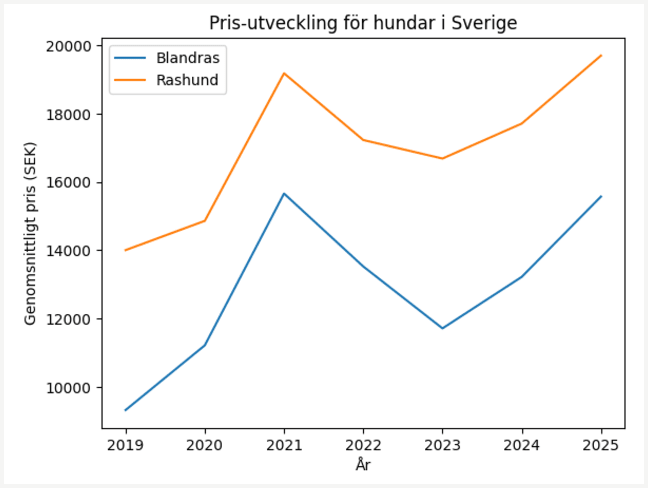
Since 2019, the average price of pedigree dogs has risen by about 40 percent. For mixed-breed dogs, the increase is even more pronounced, with an increase of over 60 percent during the same period. After a clear peak during the pandemic years, the price trend eased somewhat, but in 2025 levels are again at or above previous peaks.
At the same time, our data shows that many buyers do not set a clear maximum price in their searches. A significant share of alerts are created without a specified price limit, which indicates that price by itself is not the main constraint. Instead, buyers seem to weigh other factors more heavily, such as clear information, serious sellers, and predictability in the transaction.
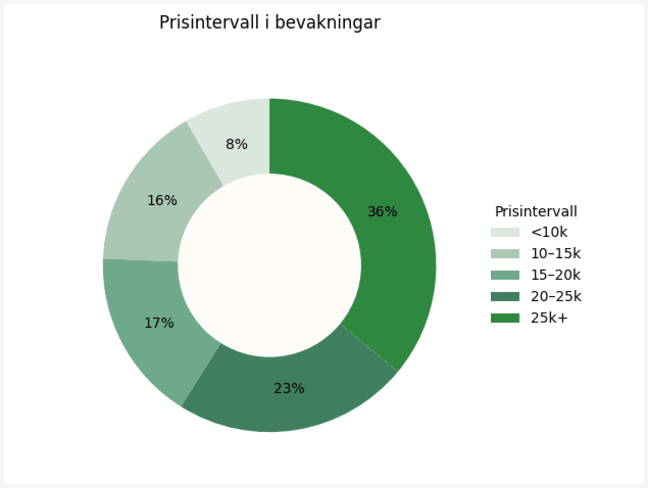
This pattern aligns well with the changing buyer profile. An older and more established buyer group often has greater financial leeway, but also higher expectations. Our data suggests that many are prepared to pay more, as long as the purchase feels safe and sustainable in the long term.
Overall, this indicates that price trends have not primarily led to reduced demand, but to more selective behavior. For the 2025 dog buyer, the lowest price is not what decides the deal, but the confidence that the purchase is right from the start.
¶Rehomings in a Broader Context
The issue of rehomings has received increasing attention in recent years, not least in connection with the after-effects of the pandemic. However, when we analyze developments over time, we see a more nuanced picture than the one often presented in public debate.
The proportion of listings for older dogs clearly increased in 2022 and 2023. During these years, the share was around 25 percent, coinciding with a period when many households returned to work and studies outside the home. It was also during this period that the total number of available dogs was at its highest.
In 2024 and 2025, however, the proportion of older dogs in listings has fallen. In 2025, the share was around 17 percent, which is in line with or lower than the pre-pandemic years. This suggests that the temporary increase has not continued, but has instead stabilized.
These developments should be interpreted with caution. Rehomings are affected by many factors, including life situation, finances, and changes in family circumstances. At the same time, our data shows no signs of a continued increase in recent years.
Overall, this indicates that rehomings remain part of the dog market today, but that developments in 2024 and 2025 are not characterized by a growing trend. Instead, the post-pandemic period appears to be a correction back toward more normal levels.
¶An Increasingly Mature Nordic Dog Market Heading into 2026
Summarizing developments in 2025, we see a dog market that has gradually matured. Fewer purchases are completed, but decisions are more considered. Requirements for information, transparency, and long-term thinking have increased, while buyers take more time before deciding.
Heading into 2026, we see few signs of a return to the high volumes that characterized the pandemic years. Our data instead points to a more stable market where quality, trust, and responsibility weigh more heavily than speed and supply. This applies both to how buyers search and to how sellers are expected to present their listings.
At the same time, it is increasingly clear that the dog market needs to be understood in a Nordic context. Although regulations and conditions differ between countries, we see many common traits in buying behavior. An older buyer group, longer decision processes, and higher demands for clarity and comparability are recurring patterns across the Nordic region.
Against this backdrop, we are taking the next step in our own development. In 2026, Skaffa Hund changed its name to Get a Pet and launched across the Nordic countries. The aim is to meet a more mature market with better overview, increased transparency, and clearer support throughout the buying process, regardless of country.
For us, this is an adaptation to the developments we are seeing. Buying a dog is increasingly viewed as a long-term commitment, where both buyers and sellers look for structures that make it easier to make well-informed and sustainable decisions.
¶About the Data
The analysis in this article is based on anonymized behavioral data from Get a Pet. The data set covers searches, alerts, and listings on the platform for the period 2019 to 2025.
The data reflects the behavior of people who are actively searching for, monitoring, or offering dogs via Get a Pet and shows how the buying process evolves over time. The information has been analyzed at an aggregated level and cannot be linked to individual users.
Our observations should be seen as a complement to official statistics from, for example, the Swedish Board of Agriculture and kennel organizations in the Nordic region. Since the data is based on activity on our platform, it primarily provides insight into the behavior and preferences of active dog buyers and sellers, rather than a complete picture of the entire market.
The purpose of the analysis is to contribute to a better understanding of how the dog market is developing and what changes are shaping dog purchases today and in the years ahead.







-(1)-fullscreen.jpg)