












¶Table of Contents
¶Quick Facts
The Continental Bulldog is a medium-sized, powerful and agile bulldog from Switzerland. It was developed as a companion and family dog by crossing the English Bulldog with the Old English Bulldog. The breed belongs to FCI Group 2 and has been provisionally, rather than definitively, recognised by the FCI since 2022. The current international breed standard was published in 2026.
- Purpose: companion and family dog
- Height at the withers: males 42–50 cm, females 40–48 cm
- Weight: usually 20–30 kg depending on size; the standard gives reference weights of about 30 kg for males and 25 kg for females
- Build: athletic and almost square, although the body should be about 20 per cent longer than the height at the withers
- Coat: short, dense, smooth and glossy; some dogs have no undercoat
- Ideal temperament: attentive, self-confident and friendly, neither aggressive nor shy
- Important health consideration: breathing and eyelids must be assessed in the individual dog; the breed’s breeding aims do not guarantee trouble-free breathing
The breed is best suited to someone who wants a sociable and active dog. Its compact build should not be taken to mean that brief toilet walks are enough. A prospective owner also needs to examine breathing, eyes and documented health results as carefully as temperament and appearance.

¶Appearance & Coat
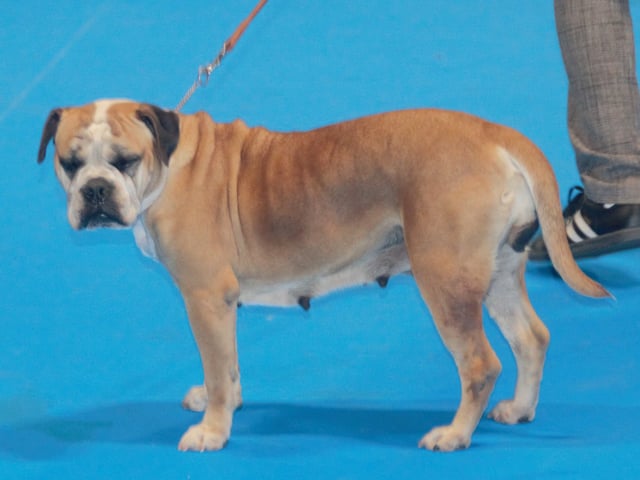
The Continental Bulldog should look like an athletic bulldog, not an extremely short-muzzled or heavy dog. Its body is compact and muscular, but it should move with an even, fluid gait. The ratio of height at the withers to body length is about 1:1.2, so the dog is slightly longer than it is tall. The official height ranges are 42–50 cm for males and 40–48 cm for females.
The head is powerful without excessive skin or wrinkles. The nose must be completely black, with large, wide-open nostrils. The muzzle should normally be about one third of the total head length, with one quarter accepted as the lower limit. This is an important functional detail: breed type must not come at the expense of open airways. The eyes should be neither sunken nor protruding, and the eyelids should fit closely without visible irritation.
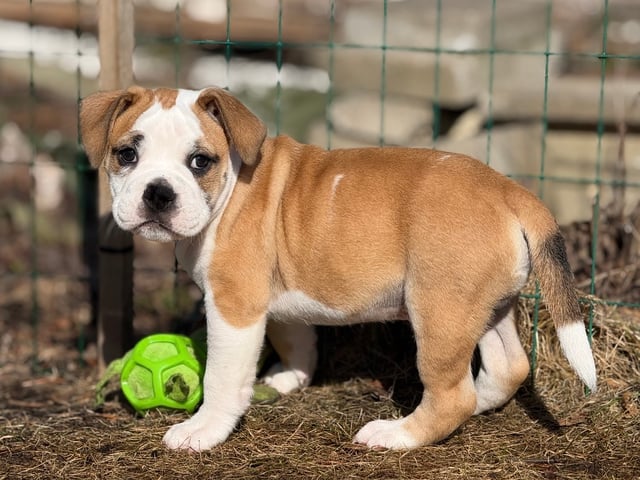
The current FCI standard from 2026 permits fawn in shades from sand to red, brindle and black. These colours may occur with varying amounts of white or a dark mask, while white may be the base colour with markings in the permitted colours. Older information stating that every colour with a black nose is accepted is therefore no longer current.
The coat is short, close-fitting and easy to inspect. Brush and bathe the dog when it genuinely needs it rather than following a fixed weekly timetable. At the same time, check the skin, paws, ears and any facial folds. Persistent redness, dampness, itching or recurring irritation should be assessed by a vet, not merely concealed by more frequent cleaning.

¶Temperament & Personality
A typical Continental Bulldog should be attentive, self-confident and friendly. This describes the breed ideal, not a promise about every puppy. Genetics, early experiences, environment, training and health all influence how an adult dog responds to people, dogs and unfamiliar situations.
The breed was developed to live closely with people and may enjoy joining in family activities. Its powerful build and playfulness, however, make calm everyday training just as important as social contact. Teach the puppy early to greet people with all four paws on the ground, wait at doors, give up objects and settle when nothing is happening. These skills help both in a home with children and when visitors arrive.
A Continental Bulldog can be a first dog for a well-informed owner who wants to train consistently and with rewards. It is a poorer choice for someone looking for a dog that is content with brief walks, can be left alone without training or will handle every social situation automatically. An adult weighing 20–30 kg also requires everyone in the household to be able to manage lead walking, encounters with other dogs and exciting situations safely.
Observe the parent dogs in everyday situations if possible. Ask how they respond to strangers, handling, encounters with other dogs and recovery after activity. A general description such as “lovely family dog” is less useful than concrete examples and a recorded behaviour assessment.

¶Training & Exercise
The Continental Bulldog needs daily physical activity, scent work, learning and opportunities to settle. There is no reliable rule in minutes that suits every adult, and a puppy’s exercise should not be governed by the simplistic five-minute rule. Age, build, surface, intensity, temperature, breathing and recovery provide better guidance than a universal timer.
Combine walks with calm scent work, engagement exercises, body awareness and short training sessions. Reward the behaviour you want and increase difficulty gradually. The breed can be both strong and enthusiastic, so lead manners, recall, impulse control and the ability to settle are practical foundation skills. Harsh corrections or training based on fear are unnecessary and may undermine both confidence and co-operation.
A growing puppy benefits from self-directed play, exploratory walks and several short everyday experiences. Avoid repeatedly asking for hard jumps, sudden stops or other loads for which the puppy is not prepared, but do not treat normal movement as dangerous. Increase activity gradually and make sure the puppy can rest undisturbed.
According to the breed standard, breathing should remain quiet even when the dog moves at speed. Stop and let the dog cool down if breathing becomes laboured, recovery takes too long or the dog loses pace and willingness. Take particular care in hot weather. Repeated breathing noise, abdominal effort, open-mouth breathing after little exertion, overheating or fainting are warning signs that require veterinary assessment.

¶Health
The Swedish population is still too small for disease prevalence to be assessed reliably. It is therefore misleading both to call the breed problem-free and to present a long list of diagnoses as though every condition were common. Breathing and eyelids are the most clearly documented risk areas, while joints, DNA results and behaviour form part of the Swedish breed club’s breeding recommendations.
The Continental Bulldog is brachycephalic and is included in the Swedish Kennel Club’s instructions for reducing conformational exaggerations. These identify laboured or noisy breathing together with an excessively short muzzle, pinched nostrils and narrow airways. Incorrectly formed eyelids are the other named risk area. In the breed standard, breathing noise at rest or in motion, as well as inward- or outward-rolling eyelids, are disqualifying faults.
Since May 2026, Continental Bulldogs have been eligible for RFG-S assessment in Sweden. The vet assesses features including the nostrils and breathing before and after exercise, and results for dogs registered with the Swedish Kennel Club can be viewed in its public records. Ask for the parents’ results and also observe how the dogs actually breathe and recover. A test result is valuable information, but it does not replace observation over time.
It is also important to distinguish requirements from recommendations. The Swedish Kennel Club’s 2026 registration rules contain no breed-specific HD or ED status requirement for the Continental Bulldog, and the group’s explicit RFG-S requirement applies to the English Bulldog. The Swedish breed strategy nevertheless recommends known HD and ED status, DNA results for cystinuria and DVL2, and a completed BPH behaviour assessment. These are relevant records to request, but they should not be described as compulsory Swedish Kennel Club tests for the breed.
Ask the breeder to show the original results and explain how they informed the choice of mating. Also ask about breathing, eyes, skin, urinary problems and movement in parents, siblings and previous offspring. For cystinuria and DVL2, find out exactly which variant was tested and how the result affected the mating; the labels “DNA tested” or “health tested” are not enough on their own.

¶History & Origins
The Continental Bulldog is a young Swiss breed with a clearly documented beginning. In 2000, the Swiss kennel organisation authorised breeder Imelda Angehrn to cross the English Bulldog with the Old English Bulldog. The first litter of the so-called Pickwick crosses was born in the summer of 2001.
The breeding programme aimed to produce a medium-sized bulldog with better mobility, quiet breathing, and natural mating and whelping. These were breeding goals, not guarantees for every dog born. When the project developed into a separate breed, the Swiss kennel club authorised continued breeding under the name Continental Bulldog on 15 September 2004. The Swiss breed club was founded that same year.
The FCI accepted the breed on a provisional basis on 30 March 2022. Provisional status means that the breed is listed internationally by the FCI but is not yet definitively recognised. The current official standard is dated February 2026 and was published in March of that year. This timeline is more accurate than simply saying that the breed gained full FCI recognition in 2022.

¶Living with the Breed
The Continental Bulldog can thrive in many types of home if daily life includes activity, recovery, training and careful health monitoring. The size of the home matters less than how the dog copes with noise, stairs, visitors, dog encounters and time alone. Flat living can work, but recurring barking or distress needs training and management; the breed name does not promise a quiet dog.
Children and dogs should always have an adult present, and the dog needs a resting place where it will not be disturbed. Its physical strength means that even friendly play can overwhelm a small child. Teach both child and dog clear boundaries and interrupt play before it becomes too intense.
The same caution applies to other animals. Some individuals live happily with dogs or cats, while others need more distance and carefully managed introductions. Base decisions on the individual dog’s experience and behaviour, keep the first meetings calm and separate the animals when nobody can supervise them. Socialisation improves the prospects but does not guarantee a particular outcome.
Time alone should be taught through very brief, calm separations and increased only when the dog is comfortable. A puppy cannot be expected to stay alone like a trained adult, and adults also vary considerably. Arrange help if everyday life requires longer absences than the dog can manage without distress.
Before buying, you should be able to answer yes to three questions: Can you provide varied activity without ignoring breathing and heat? Can you handle a powerful adult dog with calm, reward-based training? Can the breeder show documented results for the parents’ breathing, eyes, joints, DNA and behaviour? If any part is missing, it is sensible to wait for a better-documented mating.
¶Characteristics
| Characteristic | Value |
|---|---|
| Breed Type | Purebred |
| Aggressiveness | 2/5 |
| Child Friendly | 4/5 |
| Energy | 3/5 |
| Hair Shedding | 3/5 |
| Health | 3/5 |
| Intelligence | 3/5 |
| Grooming Needs | 3/5 |
| Learning Ability | 3/5 |
| Barking Level | 2/5 |
| Height | 40 – 50 cm |
| Weight | 24 – 30 kg |
| Life Expectancy | 10 – 13 years |
¶Frequently Asked Questions
What is a Continental Bulldog and how is it different from the English Bulldog?
It is a modern, medium‑sized bulldog type developed to be more athletic and healthier than the traditional English Bulldog. It generally has a slightly longer muzzle, less extreme wrinkles and a more functional body structure that copes better with heat and exercise.
Do Continental Bulldogs have fewer breathing problems than other bulldog breeds?
They are specifically bred with a longer nose and less exaggerated head shape to reduce the risk of brachycephalic breathing issues. While they typically cope better with activity and warm weather than many bulldogs, they can still overheat and should be managed carefully in hot or humid conditions.
What is the typical temperament of a Continental Bulldog with family members and children?
They are usually calm, people‑oriented and affectionate, often forming a close bond with their family. With proper socialisation they are generally patient and tolerant with children, though their solid build means supervision is wise around very small kids.
How much exercise does a Continental Bulldog realistically need each day?
Most adults do well with around 45 to 75 minutes of daily activity, split into a couple of walks and some play or training. They enjoy moderate exercise but are not endurance dogs, so sessions should be adapted to their fitness level and weather conditions.
Are Continental Bulldogs suitable for apartment living?
They can adapt well to apartment life because they are generally calm indoors and not excessively noisy. Daily walks, mental stimulation and clear routines are essential, and stairs or slippery floors should be managed carefully to protect joints.
What health problems are Continental Bulldogs prone to?
The breed was created with health in mind, but issues such as hip and elbow dysplasia, joint problems, eye conditions and some skin sensitivities can still occur. Responsible breeders screen parents, and owners should keep their dog lean and well exercised to support joints and overall health.
How much grooming and skin care does a Continental Bulldog require?
Their short coat is low maintenance and usually needs only weekly brushing and occasional baths. Facial folds, if present, should be checked and gently cleaned as needed to prevent moisture buildup and irritation, and nails often require regular trimming.
Can a Continental Bulldog be left alone during the workday?
They are strongly attached to their people and may struggle if left alone for long hours without preparation. With gradual training, a predictable routine and appropriate enrichment, many cope with a standard workday, but this is not a breed that thrives on very isolated living.
How well do Continental Bulldogs get along with other dogs and pets?
With early and consistent socialisation they usually get along well with other dogs and can live peacefully with other household pets. Some individuals may be a bit dominant or pushy, so good manners training and controlled introductions are important.
What should I know about feeding and weight management for a Continental Bulldog?
They can gain weight easily, which puts extra strain on joints and breathing. A measured, high‑quality diet, limited treats and regular monitoring of body condition are key, and your vet can help you set an ideal weight target for your individual dog.
¶Comparisons with other breeds
Compare Continental Bulldog with other breeds and see the differences in temperament, activity level, and care to make a confident choice. Show all comparisons