¶Has Your Dog Eaten a Mushroom or Acorn? What to Do on an Autumn Walk
A quick bite among the leaves can be difficult to assess.
Your dog stops at the edge of the path, lowers its nose, and takes a bite. By the time you get there, all you can see are wet leaves. On autumn walks, it can be hard to tell whether your dog was simply investigating the ground or actually swallowed something. That is why a simple action plan is more useful than trying to learn to identify every mushroom in the woods.
If your dog has eaten an unknown mushroom, contact a veterinarian immediately for an assessment. You should also contact a veterinarian right away if your dog has eaten acorns. Explain how much your dog may have ingested, its size, and how it is feeling. Do not wait for its condition to change if you suspect poisoning. Read Evidensia’s advice on suspected poisoning in dogs.
At the same time, the aim on an ordinary autumn walk is to let your dog continue sniffing and moving around. A few carefully considered route choices, a shared family routine, and the right information for the veterinarian can make the situation more manageable.
¶What to Do First If Your Dog Has Swallowed Something
1. Move away from the area
Take your dog somewhere it cannot reach any more of the suspected substance. Keep your dog on the leash and ask another adult to hold it if you need to inspect the ground. If you are alone, looking after your dog and contacting a veterinarian are more important than searching for every remaining piece.
2. Call and describe exactly what you saw
Say whether you saw your dog swallow, chew, or merely sniff something. Explain whether you saw a whole mushroom, part of a mushroom cap, an acorn, or something you could not identify. Distinguish observation from guesswork: “I saw my dog take one bite, but I don’t know how much is missing” is more useful than giving a confident estimate without evidence.
Have your dog’s approximate weight, the time of the incident, and details of any symptoms ready. Also mention any medical conditions and medications. If you are far from the nearest clinic, say so early in the conversation so the advice can take travel time into account.
3. Collect evidence if you can do so quickly
Photos of the mushroom from several angles and a picture of where it was growing may help with identification. If possible, keep any remnants separate and out of your dog’s reach. Explain whether the sample came from the mushroom your dog ate or from another one growing nearby. They may not be the same species.
Reliable species identification is important when assessing the risk. However, an identification provided by an image recognition app is not a reason to avoid contacting a veterinarian.
4. Follow the veterinarian’s instructions
Do not try to make your dog vomit using salt or other home remedies. Do not administer activated charcoal, medication, or any other treatment on your own initiative. Evidensia emphasizes that you should never try to induce vomiting yourself. Ask the veterinarian to clarify whether you need to bring your dog in and where you should go.
¶Mushrooms and Acorns Pose Different Risks
Not all mushrooms are poisonous, but you cannot determine whether an unknown mushroom is safe based on it being small, brown, or lacking any red coloring. The species your dog has eaten is crucial. Some mushroom toxins cause gastrointestinal problems, while others may affect the nervous system, liver, or kidneys. Symptoms may also be delayed, as Trygg-Hansa explains in its guide to poisonous mushrooms.
Acorns can cause serious problems with a dog’s liver and kidneys. Evidensia discusses acorns in its guide to plants that are poisonous to dogs and emphasizes that ingestion requires prompt treatment. Contact a veterinarian if your dog has eaten acorns. Explain when it happened, how much your dog may have ingested, your dog’s weight, and how it is feeling. Let the veterinarian determine what needs to be done.
The table below can help you distinguish between different situations when describing the incident. It does not replace a veterinarian’s assessment.
| What you saw | What you need to report | Next step |
|---|---|---|
| Your dog swallowed an unknown mushroom | The time, approximate amount, weight of your dog, and any photos | Contact a veterinarian immediately |
| Your dog ate acorns | The number, if known, whether they were whole or chewed, and how your dog is feeling | Contact a veterinarian immediately for advice |
| Your dog chewed something among the leaves, but you do not know what it was | What was present in the area and exactly what you saw | Call a veterinarian if your dog may have swallowed something poisonous |
| Your dog sniffed something, but you did not see it eat anything | No confirmed ingestion | Move your dog away and prevent it from eating the item |
¶A Dog That Seems Fine Is Not Necessarily in the Clear
Your dog wanting to continue the walk only tells you how it appears to be feeling at that moment. It does not prove that what it swallowed was harmless. If you suspect mushroom poisoning, do not conduct your own test by waiting for your dog to vomit before calling.
Symptoms that may occur after eating a poisonous mushroom include vomiting, diarrhea, and tremors. These signs are described in Trygg-Hansa’s guide to poisonous mushrooms, but they do not indicate which type of mushroom your dog ate.
If your dog has seizures, collapses, or experiences difficulty breathing, it needs emergency veterinary care. Call the nearest open animal hospital for instructions. If a veterinarian has already assessed your dog but its condition worsens, contact them again and explain what has changed. Read Evidensia’s guidance on poisoning in dogs.
This guidance comes from the Swedish Poisons Information Centre’s information about pets. Before your next walk in the woods, save the numbers of both a veterinary clinic and an emergency animal hospital in your phone.
¶Adapt Your Route to Where Your Dog Actually Walks
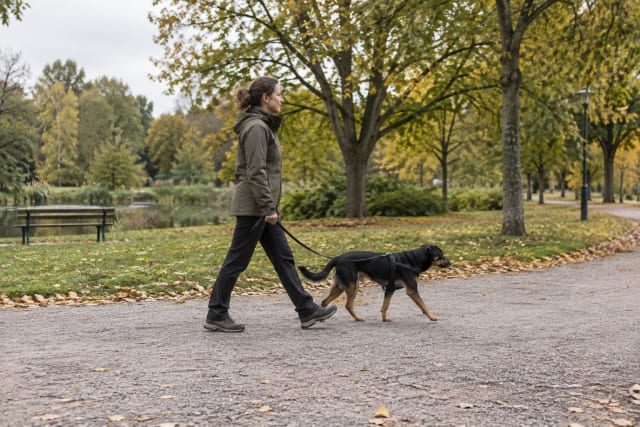
Review your usual route with your dog’s nose height in mind. Where does your dog stop the longest? Are there oak trees near the parking area, mushrooms along the edge of the grass, or a corner of the garden that your dog investigates unsupervised?
Then make a mental map of the places where closer supervision is needed. It may be enough to walk along the other side of a grassy area, pass an oak tree without stopping to sniff, and allow a longer sniffing break somewhere with a clearer view. A leash only helps if you can also see what your dog can reach.
On evening walks, you need to be able to see the ground in front of your dog. Bring a flashlight and choose a route with good visibility, especially if your dog likes picking things up. This means you will not have to try to work out what your dog chewed several yards away in the dark.
In the garden, check the areas where your dog usually spends time and remove any visible mushrooms and fallen acorns. Treat this as a recurring check, not as a guarantee after a single cleanup. When you return home, also keep mushroom baskets and trimmings out of your dog’s reach.
¶Practice “Leave It” and Trading in a Safe Environment
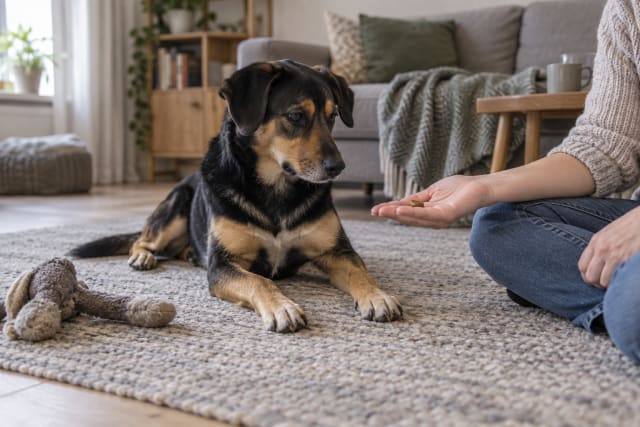
A learned “leave it” or “drop it” cue is useful, but it should be practiced when nothing dangerous is at stake. In reward-based trading exercises, your dog receives something it values when it willingly releases an object.
Start at home with a safe toy your dog is happy to give up. Offer a better reward, praise your dog calmly when it releases the toy, and sometimes let it have the toy back. Add your chosen cue once the trade is working. Practice in short sessions and gradually increase the difficulty.
Never use real mushrooms or acorns as training materials. The aim is to teach your dog a clear routine, not expose it to danger to test whether it will obey. Continue adapting your walks even when the exercises work well at home.
¶Give Your Dog Sitter More Than a General Warning
Anyone walking your dog needs to know the specific risks along your usual route. “Watch out for mushrooms” is less useful than “Walk past the oak tree by the playground without stopping, and take the sniffing break farther along.” Also show them which cue you use when asking your dog to trade an object.
Provide the veterinarian’s contact details and ask the dog sitter to call if they suspect your dog has swallowed something, even if it seems fine. Decide how you will contact each other and who can arrange transportation. For more things to cover when handing over your dog’s care, see our guide to dog daycare, a dog sitter, or staying home alone.
A good autumn routine does not have to make every walk stressful. It should make it easier to choose a suitable route, let your dog sniff under supervision, and know what to do next if