
Due to the widely publicized debate about so‑called “fighting dogs,” we have chosen to present statistics and common questions about “fighting dogs,” dog bites, and irresponsible dog owners.
Statistics 2016–2022 from the National Board of Health and Welfare (Socialstyrelsen)
Number of injuries or poisonings that occurred in connection with being attacked or bitten by a dog
| Year | Number of injuries | Number of dogs | Injuries / dog | Increase, number of dogs |
|---|---|---|---|---|
| 2016 | 3,686 | 870,000 | 0.42% | – |
| 2017 | 3,810 | 895,000 | 0.43% | 2.87% |
| 2018 | 3,754 | 919,000 | 0.41% | 2.68% |
| 2019 | 3,850 | 948,000 | 0.41% | 3.16% |
| 2020 | 3,556 | 989,000 | 0.36% | 4.32% |
| 2021 | 3,950 | 1,041,323 | 0.38% | 5.29% |
| 2022 | 4,302 | 1,089,000 | 0.40% | 4.58% |
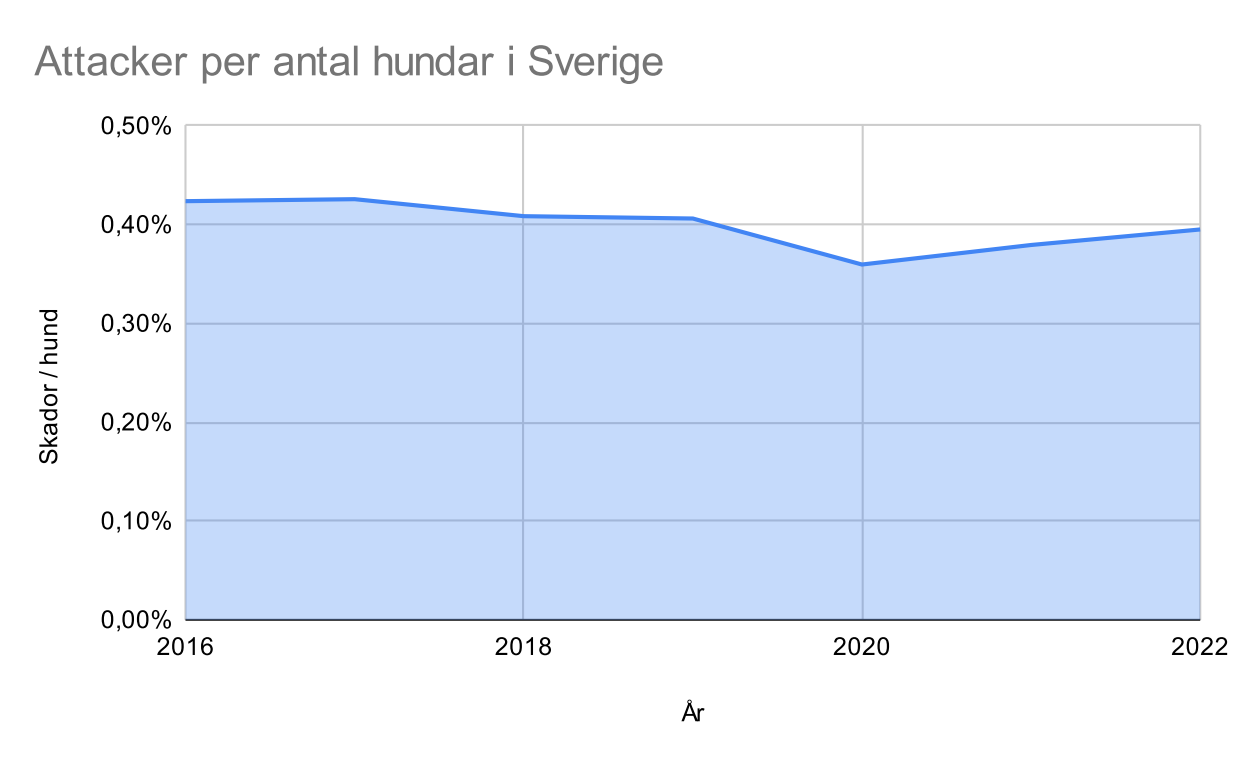
Even though there have been more attacks, due to the increased number of dogs, the number of dogs taken into custody has not increased (see below).
¶Number of dogs taken into custody 2019–2021
| Breed group | Dogs taken into custody | Most common breeds |
|---|---|---|
| Sheepdogs and cattle dogs | 13 | German Shepherd |
| Pinschers, Schnauzers, Molossers, Mountain Dogs and Swiss Cattle Dogs | 19 | Rottweiler, Boxer, Dobermann |
| Terriers | 37 | Amstaff, American Bully, Pitbull etc. |
| Spitz and primitive types | 2 | Siberian Husky |
| Flushing, retrieving and water dogs | 5 | Labrador |
| Sighthounds | 2 | Saluki |
| Mixed breeds / Unknown breed | 11 |
In total, 89 dogs were taken into custody by authorities between 2019 and 2021.
American Staffordshire Terrier and Amstaff mixes
The American Staffordshire Terrier, or Amstaff, was the breed that was taken into custody most often during 2019–2021. Of a total of 89 cases, the purebred American Staffordshire Terrier was taken into custody 9 times. Mixed breeds with Amstaff in them were taken into custody 11 times, which means that out of 89 dogs in total, Amstaff was present in 20 of them, accounting for 22% of all dogs.
¶Can we draw conclusions from the dogs that were taken into custody?
Certain breeds are overrepresented among the dogs taken into custody by the police. These breeds are likely to correlate with the number of dog bites per breed.
One example is the number of Labrador Retrievers and Amstaffs (figures from 2017):
- There are 28,900 Labrador Retrievers in Sweden, of which 4 were taken into custody between 2019 and 2021 due to attacks or dog bites – i.e. 0.014% of all Labrador Retrievers in Sweden were taken into custody.
- At the same time, there are 8,650 American Staffordshire Terriers in Sweden, of which 9 were taken into custody during the same period – i.e. 0.104% of all American Staffordshire Terriers in Sweden were taken into custody.
- It is therefore 7.5 times more common in Sweden for an American Staffordshire Terrier to be taken into custody than a Labrador Retriever.
¶What responsibilities do dog buyers and breeders have?
By law, it is the owner’s responsibility to train and handle their dogs in a way that is safe for other people and animals.
Some dog breeds have traits that owners need to be aware of. That is why educational material that dog owners can and should take part in is so important. On skaffahund.se there is a large amount of useful and easily accessible information that dog owners can access completely free of charge.
It is also extremely important that breeders of fighting‑type dogs choose buyers carefully and always act in the best interests of the dog.
In the debate about certain breeds, some people believe that “dangerous dogs” should be banned, while others think the focus should be on educating owners rather than restricting certain breeds. We believe that education should be the primary focus, and that it is crucial to carefully assess whether a person who wants to buy a dog with a higher risk of developing aggressive behaviour is a suitable owner or not.
¶How common are dog attacks?
According to a new 2023 survey by Agria, 25 percent of dog owners have experienced dog attacks where their dog was injured, and 4 percent of those cases were so serious that the dog died.
¶Responsible authorities should improve their records
We believe that the National Board of Health and Welfare and the police should improve their records of dog attacks so that new dog owners can properly read up before deciding on a breed. There is a need for greater transparency and for this information to be compiled and published annually.
Questions and answers
¶What is a “fighting dog”?
The term “fighting dog” is unfortunately often used carelessly and without justification, which leads to prejudice against purebred dogs, mixed breeds, or dogs that match certain visual or behavioural stereotypes. The term “fighting dog” covers all kinds of dog types and breeds that have historically been used around the world in various forms of combat – such as dog fighting, bear‑baiting, and other animal baiting.
¶Are there dangerous dog breeds?
In general, there are no inherently dangerous dog breeds, but there are breeds with traits that owners should be aware of. Most dogs have the potential to become more or less dangerous to those around them, which may be due to selective breeding and poor handling by their owners.
SkaffaHund.se aims to support future dog owners by providing information about different breeds and guiding them in choosing the right one. This initiative includes the SkaffaHund.se website, where relevant information and resources are available to help prospective owners choose a suitable breed and practise responsible dog ownership.
¶Are dangerous dog breeds a social problem?
Whether dangerous dog breeds constitute a social problem is a controversial question and depends heavily on perspective. Some people believe that dangerous dog breeds pose a real threat and can lead to hazardous situations, while others argue that the problem lies in how dogs are raised and managed by their owners rather than in the breed itself.
Arguments for dangerous dog breeds being a social problem include:
- Risk of injury: Some breeds have a higher risk of causing serious injuries if they become aggressive. This can mean an increased risk of harm to people and other animals.
- Feeling unsafe: When people feel threatened by dogs – especially by certain breeds – it can affect the general sense of safety in society.
On the other hand, proponents of the breeds argue that:
- Owner responsibility: It is the owner’s responsibility to train and manage their dogs in a safe way. Many believe the focus should be on educating owners rather than restricting certain breeds.
- Generalisation: Judging a dog based on its breed can be an unfair generalisation, since individual dogs can have very different personalities and temperaments.
¶How many dangerous dogs are there in Sweden?
There are no statistics on this in Sweden. There are over 1.1 million dogs owned by more than 813,000 people. Only a very small number of these dogs are dangerous. We believe authorities should keep more detailed statistics on dog attacks and bites, and that this information should be easier to find. There should also be more statistics for each individual breed so we can see whether any specific breed is more dangerous than others.
¶Are some breeds unsuitable for certain dog owners?
Of course, not every breed suits every owner. Some breeds require more knowledge and experience from the owner, which is why you should read up thoroughly on the breed you are interested in before contacting a seller.
¶What does Skaffa Hund do to prevent unsuitable dogs and owners?
Skaffa Hund works with several authorities and organisations to prevent unsuitable dogs and owners. We have created a number of processes to encourage dog owners to be as responsible as possible. This includes educational content, guides, and training videos.
We also have a unique system in Sweden with a set of questions that every buyer must answer before they can contact a seller. This is intended to reduce the risk of someone buying a dog they are not able to handle. Based on these answers, sellers can then filter out unserious or unsuitable buyers.
Dog bites
¶Why does a dog bite?
A dog can bite a person for many different reasons. It might happen during play, in which case the dog is not trying to cause harm. It might bite because it feels the need to protest, communicate, or set a boundary. A dog can also bite if it feels scared, stressed, or threatened.
¶How common is it for a dog to bite another dog?
There is no comprehensive, reliable statistic on this, but several surveys have been conducted. In one of the most recent, carried out by PFM Research on behalf of Agria with 300 dog owners participating, 27 percent reported that they had experienced a dog fight. Many of these incidents may have occurred at home between familiar dogs, or while out walking when meeting an unfamiliar dog. Based on this survey, almost one in three dogs will at some point end up in a dog fight.
Sources:
<sup>Bedömningsgrunder vid omhändertagande av hund</sup>
<sup>Biten eller angripen av hund – en allt vanligare diagnos</sup>
<sup>Forskning visar – kamphundsraser bakom flest hundattacker</sup>
<sup>Hundslagsmål – Hög risk för skador</sup>