
¶Table of Contents
¶Quick Facts
The Basset Artésien Normand is a short-legged French scent hound for someone who genuinely intends to hunt with their dog. In Sweden, the breed is used on deer, roe deer, hare and fox, and occasionally rabbit. It follows a trail carefully, drives game at a measured but purposeful pace and uses its voice while working. The Swedish Kennel Club stresses that the breed is not suitable solely as a companion.
- Purpose: slow-driving scent hound and tracking dog
- Breed group: Group 6, scent hounds and related breeds
- Origin: France
- Size: 30–36 cm at the withers and usually 15–20 kg
- Coat: short, smooth and close-fitting; tricolour or bicolour
- Temperament: outgoing, cheerful and very affectionate, yet independent when searching
- Most important consideration: an interest in hunting, safe handling away from the hunt and a willingness to enter working trials matter more than the size of the home
The breed can be a close family member alongside its hunting work, but family life does not replace the job it was bred to do. The clearest question before buying one is therefore not whether the dog looks conveniently small, but whether everyday life will include the hunting and training the breed needs.
¶Appearance & Coat
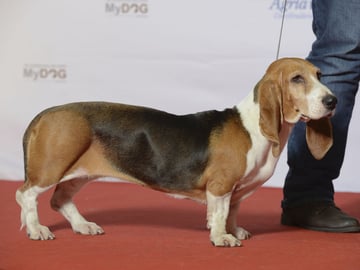
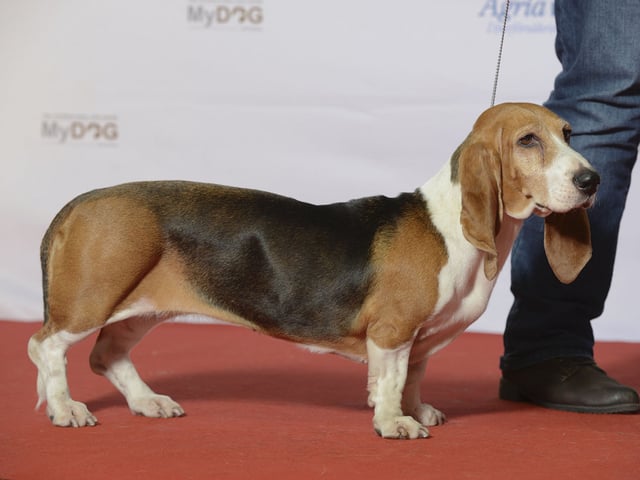
The Basset Artésien Normand is low to the ground but not slight: its body is robust, balanced and long in relation to its height. The breed standard gives an approximate ratio of five parts height at the withers to eight parts body length. The chest should be oval and long, with a sternum extending well back. Despite the short legs, the construction must allow free, even movement.
The forelegs are short, strong and half-crooked, or slightly less bent. The curve is part of breed type, but it must not become an exaggeration that compromises contact with the ground. The feet should stand firmly with good support, and movement should be even, fairly effortless and steady. For a working hound, this matters more than an excessively heavy body or an extremely low front.
The head has low-set, fine and very long ears. The nostrils should be well open. The short coat lies close and is either fawn and white with a black mantle, or fawn and white. It needs little work, and the dog is bathed when necessary. Keep an eye on the ears because ear problems are documented in the breed. Recurring problems should be assessed by a vet, and care should be tailored to the individual dog.
¶Temperament & Personality
The Basset Artésien Normand should be outgoing and very affectionate. It generally wants to be close to its family and works with the hunter, but that partnership does not mean waiting for an instruction at every step. When searching, the hound needs to make its own decisions, follow scent and work with stamina.
This makes the breed both sociable and independent. Affection at home does not make the hunting drive disappear outdoors, and independence does not mean the dog is impossible to train. A good handler develops engagement and clear habits without trying to remove the quality for which the hound was bred.
Claims that the breed is always good with children, always accepts cats or automatically gets on with every dog are too definite. Individuals, previous experiences and introductions all matter. The breed's characteristically friendly nature is a good starting point, but every relationship still needs to be built and monitored.
¶Training & Exercise
The Basset Artésien Normand needs hunting work, not simply a set daily walk length. When driving game, the hound uses its nose independently, moves through dense cover and follows persistently without going fast. In Sweden, the breed works on deer, roe deer, hare and fox, among other quarry. The international standard also describes rabbit as typical quarry.
Working trials provide a practical way to assess driving work, cooperation and other qualities needed in breeding. A prospective owner should therefore ask how the parents work, what trial results they have and what help the breeder offers with introducing the young hound to hunting and entering trials. Tracking exercises and other scent work can complement training, but they should not be used to justify buying the breed without a plan for its main job.
Everyday training works best with rewards, short clear exercises and consistent routines. Prioritise engagement, walking on a lead, a stop cue and recall from an early age. A well-trained recall reduces risk but does not cancel the hunting instinct of a driving hound. Away from controlled hunting, off-lead freedom should therefore be supervised and limited to secure surroundings; a lead or long line is often the responsible choice where game may appear.
Exercise should reflect the dog's age, fitness, terrain and workload. No single number of minutes suits every individual. Instead, consider whether the dog maintains a healthy weight, moves freely, recovers normally and can settle at home.
¶Health
The Swedish Kennel Club describes the breed as having few health problems, while also identifying ear and throat conditions and hunting-associated pulmonary oedema. The evidence is limited, and older figures should not be read as current prevalence. A 2011 breed-club survey received information on 198 of 542 dogs, a response rate of 37 per cent. Ear inflammation, throat infection and signs consistent with pulmonary oedema were each reported for 4 per cent. This is a historical sample, not a current measure of risk for an individual puppy.
Hunting-associated pulmonary oedema is the most important acute condition to watch for in a working hound. Abnormal breathing or fatigue clearly greater than expected during or after hunting must be taken seriously: stop the work and have the dog assessed promptly by a vet. Heritability research often quoted in this context concerns the Drever and cannot simply be transferred to the Basset Artésien Normand. No reliable current prevalence or heritability has been established for this breed.
The older breeding strategy also describes so-called basset lameness, or premature closure of a growth plate. In this condition, the radius continues to grow while growth of the ulna stops, which can cause foreleg lameness. Cases had been reported, but their number was unknown. Lameness in a growing dog should therefore be examined by a vet rather than dismissed as a normal consequence of curved forelegs.
The breed is not individually highlighted in the Swedish Kennel Club's current judging guidance on conformation exaggerations. Its general text for basset breeds nevertheless emphasises a sound front, paw pads with proper ground contact and a well-formed chest. When meeting the parents, watch them move and ask how the breeder follows up lameness, chest construction, ear and throat problems, and hunting oedema in the line.
The Swedish Kennel Club's 2026 registration rules require no health examination specifically for this breed when litters are registered. That does not mean health questions can be skipped. Ask for specific information about the parents and close relatives, how the dogs have recovered after hunting and any veterinary diagnoses, rather than accepting only that “the breed is usually healthy”.
¶History & Origins
The Basset Artésien Normand was developed in France as a short-legged, short-coated hunting hound. Controlled breeding of short-coated French basset types gathered pace around 1870. Count Le Couteulx de Canteleu shaped a more utilitarian Artois type with straighter forelegs, while Louis Lane developed a Normand type with a more crooked front.
The name Basset Artésien Normand was adopted in 1924. The breed's low construction allowed it to work in dense cover that was harder for larger hounds to enter, while its moderate pace allowed the hunter to follow the work. The first Swedish litter was born in 1966, and Swedish breeding has since maintained a clear focus on the breed's function as a driving hound.
¶Living with the Breed
The Basset Artésien Normand is best suited to an active hunter who also wants an affectionate dog at home. It can take part in everyday family life, but a prospective owner needs to accept three things from the outset: hunting drive is central, the voice is powerful, and safety away from hunting requires planning.
The type of home matters less than opportunities to work, spend time outdoors and be managed safely. A powerful hunting voice does not mean every individual is noisy indoors, but sound levels are relevant when living close to neighbours. Time alone must be introduced gradually, beginning with brief, secure periods; a young puppy cannot be left alone, and adult dogs vary greatly in what they can manage.
In a family with children, an adult should be present and teach both children and dog to respect rest, food and body language. The breed's very long ears must not be pulled. Living with other dogs or cats should be assessed individually and developed through calm, controlled introductions. Outdoors, the owner must expect scent and movement to awaken hunting interest even in a dog that is friendly with the family's animals.
Before buying, you should be able to answer yes to these questions:
- Do I have a genuine plan for hunting, starting the young hound and preferably entering working trials?
- Can I let the dog move freely in a safe way without relying blindly on recall?
- Has the breeder openly described working results, movement and health in close relatives?
- Can I respond quickly to abnormal breathing, unusual fatigue or lameness?
- Does a powerful voice and an independent scent hound fit my everyday life?
If the answers are yes, the Basset Artésien Normand can combine careful hunting work with a strong bond at home. If hunting is absent, choose another breed.
¶Characteristics
| Characteristic | Value |
|---|---|
| Breed Type | Purebred |
| Aggressiveness | 3/5 |
| Child Friendly | 3/5 |
| Energy | 4/5 |
| Hair Shedding | 3/5 |
| Health | 4/5 |
| Intelligence | 4/5 |
| Grooming Needs | 2/5 |
| Learning Ability | 4/5 |
| Barking Level | 4/5 |
| Height | 30 – 36 cm |
| Weight | 15 – 20 kg |
| Life Expectancy | 12 – 15 years |
¶Frequently Asked Questions
What kind of temperament does the Basset Artésien Normand have at home and with children?
This breed is typically calm, gentle and people oriented, with a steady, affectionate nature. They usually get along very well with respectful children and enjoy being involved in family life, but their hunting background means they can be determined and occasionally stubborn. Early socialization helps them stay confident and well mannered in a busy household.
How much exercise does a Basset Artésien Normand really need despite its short legs?
Although the legs are short, this is an active scent hound that needs at least one to two hours of daily activity, ideally including long, steady walks and opportunities to sniff. They are built for endurance rather than speed and can walk for surprisingly long periods. Without enough exercise and mental stimulation they may become vocal or develop nuisance behaviors.
Are Basset Artésien Normands good apartment dogs or do they need a garden?
They can adapt to apartment living if they receive sufficient outdoor exercise and sniffing time every day. However, they are hunting hounds with a strong voice and may bay when excited or left alone, which can bother neighbors. A secure garden is helpful but not essential so long as walks are frequent and varied.
What are the most common health problems in Basset Artésien Normands?
The most frequent concerns are ear infections due to their long, pendulous ears and potential back or joint strain related to their elongated body and short limbs. Obesity is also a risk and can worsen orthopedic issues. Responsible breeders screen for hereditary problems and careful weight management plus sensible exercise are important throughout life.
How difficult is it to train a Basset Artésien Normand given its scent hound background?
They are intelligent and understand commands well but are strongly guided by their nose and can be independent thinkers. Short, consistent sessions using food rewards and praise usually work best, as harsh methods tend to make them shut down. A reliable recall is challenging, so many owners use long lines or secure areas when off leash.
What grooming does a Basset Artésien Normand need, especially for the ears and skin folds?
The short coat only needs weekly brushing to remove loose hair, with more frequent brushing during seasonal shedding. Their long ears should be checked and gently cleaned regularly to prevent infections, and any skin folds, especially around the neck, need to be kept clean and dry. Nail trimming and routine dental care are also important.
How strong is the hunting and scent drive in a Basset Artésien Normand, and can it live with cats or small pets?
The breed has a pronounced scent drive and was developed for tracking game at a steady pace, so it tends to follow its nose and may ignore recalls when on a trail. Many individuals can live peacefully with resident cats if raised together, but they may chase unfamiliar small animals outdoors. Supervision and careful introductions are essential with smaller pets.
Is the Basset Artésien Normand prone to barking or baying, and can this be managed?
Vocalization is typical, as they were bred to communicate with hunters using a melodious bay. They may bark or bay when excited, lonely or alerted to scents and sounds. Early training, adequate exercise and avoiding reinforcement of attention seeking noise help reduce excess barking, but complete silence is unrealistic for the breed.
What should I know about feeding and weight control for a Basset Artésien Normand?
Their sturdy, low slung body gains weight easily, and extra kilos put significant strain on the spine and joints. Measured meals, limited high calorie treats and regular body condition checks are essential. Many owners use part of the daily ration as training rewards or for scent games to keep them mentally occupied without overfeeding.
Is a Basset Artésien Normand suitable for a first time dog owner?
A patient first time owner who appreciates hound characteristics can do well with this breed if they commit to training, daily exercise and scent management. They are generally gentle and sociable but their independence, vocal tendencies and tracking instinct can surprise beginners. Enrolling in positive reinforcement training classes and seeking breeder or club support can be very helpful.
¶Comparisons with other breeds
Compare Basset Artésien Normand with other breeds and see the differences in temperament, activity level, and care to make a confident choice. Show all comparisons